
Asking 'Uncomfortable Questions'? Be Prepared for a Propagandist's Response

A few months ago, I published a popular article that summarised elements of propaganda theory that can be helpful to keep in mind when we're having those 'difficult conversations':
 Ursula Edgington

In that article, I first re/visited the essential elements of every good quality debate. The five main points from David Charalambous' team's excellent resources on ReachingPeople.net provide some reflective questions which are proven to be successful ways to improve outcomes during those 'difficult conversations':
- Is the argument relevant (not a generalisation)?
- Are the debater's facts incorrect? (it's not personal, it's the statement that needs correction).
- What explanation is provided (is it specific enough)?
- Does the argument have coherence (flows into, and is logical in similar contexts)?
- Is the debater focusing on an important point (explanation maybe correct, but something else demands higher priority)?
If you're new to my work, I'd encourage you to read that piece first. In my follow-up to that article, I'm providing two examples from my own communications - one that was personal, but that the author encouraged publication of, and another already in the public arena. These communications help to clearly demonstrate how the hijacking of our 'uncomfortable questions' comes about, and specifically how propaganda that controls/contains the narrative can come in all forms and from all sources - including Camp 2. A shout out to the work of Emeritus Prof Brian Martin's work on the Corporate Playbook for insights into this topic, for instance his Suppression of Dissent.
Many of my readers will be aware of the ongoing concerns that several independent researchers and I raised (and continue to raise) about what David A Hughes helpfully defined as 'Camp 2'. In particular, the well-established news platform called UK Column News (UKC) came under the spotlight. There's no need to repeat those concerns here. Nevertheless, there's various articles if readers want to learn more about that subject. For instance, my initial Feb 2025 article here, regarding formal changes to UKC shareholding; David A Hughes' articles and interviews; Hrvoje Moric of Geopolitics & Empire's comprehensive article about the growing Multipolarista's influence, interviews by Robert Cibis of OVAL.media on TWT and Michael Ginsburg of Actionable Truth Media's research and interviews here (and more). More recently, Iain Davis wrote a thoughtful article about the wider implications for our freedom from censorship after UKC's somewhat contradictory 'rebuttal' of these concerns.
So what? !
I'm making use of this context to show practical examples of how our 'uncomfortable questions' can be become 'dangerous'; get deflected, dismissed or deliberately misdirected by those who apparently seek to disrupt debating strategies - online or face-to-face - perhaps for their own agendas. In particular, I'm concerned about organisations' ongoing requests for 'donations' to 'help keep them going', when it is unclear how these donations are being used, and why they are needed at all. In that respect, in my original article about UKC I also illustrate how Voices for Freedom (RealityCheck Radio) were problematic. And in my recent article about entities that claim to be 'Freedom Universities', I raise similar 'uncomfortable questions'. Do these people deserve our hard-earned, tax-paid dollars?
I had previously enjoyed a low-key but positive association with UKC - they had published two of my research articles in 2023 (now archived) - Can we trust our universities and colleges? (co-authored with G. Moss) and Blair, Gates and Google: How education was captured. In June 2024 Debi Evans and I recorded a conversation about New Zealand in the covid era (available here). In July 2024, Charles Malet and I had what I considered to be a productive 'off-the-record' conversation comparing Kiwi/British cultural differences in self-sufficiency and farmers' geofencing. We agreed to record an interview about these topics, but confusingly, my subsequent comms fell into a black hole. Maybe the timing was significant?
In Feb 2025 myself and others raised questions on various UKC platforms, including the community forums, about the evidence on UK Companies House, which confirmed UKC's new shareholder was YMS Market Access Ltd, a company affiliated to China and registered in Hong Kong. For a small, well-established 'independent' media outlet, based in Plymouth, Britain, this radical financial/political shift was unexpected, to say the least. Hence the 'uncomfortable question':
Q: Who are YMS Market Access Ltd based in Hong Kong?
There was no response to what I considered a reasonable question posed, so I assumed this had been ignored, censored or shadow-banned - this inevitably raised even more concerns. When I published my 2025 article, I was a current, paying subscriber and voluntary author-contributor to UKC. Neither my article, nor subsequent email correspondence drew an answer to my (our) question, instead, the debating tactics that I described above, were subverted.
Below is a thread with one of the Directors of UKC. For clarity, in the application of the five discussion points summarised above, I've emphasised in bold the relevant phrases where the author's argument is using :
a generalisation (as per point 1 above), where the facts are incorrect and/or the author gets unnecessarily personal (against me and/or another) and,
emotive (point 2), where the explanation is not specific and/or the response...
has no coherence or logic (points 3 & 4) and finally, as in point 5, the author is -
making a factually-correct point, but something else is far more important (i.e. the answer to the question)!
All these strategies serve the author by avoiding answering the legitimate (but uncomfortable) question raised (in this case, about the foreign shareholder/investment).
***
Dear Ursula,
You may consider it to be a legitimate question, but I very much doubt you would have thought to ask it, had [redacted - at the time, an unknown individual] not pumped out [their] parvum opus.
Having once tried to besmirch the name and reputation of UK Column, you are now trying to force my hand, with the offer of a follow-up piece. Looking at how the first one panned out, I have little interest in looking at any more. Write what you like, Ursula, I will not be dictated to by your complete failure to understand the distinction between the roles and responsibilities of company officers and shareholders.
You have made an extremely bad judgement call, so it's really up to you where you go from here.
All the best, Charles
Charles Malet, UK Column
Note in the above how my question is not addressed - because rather than address any facts or debate that they are in/correct, instead the author chooses to use emotive language throughout, and in a derogatory tone, eg "you consider it" and "very much doubt you would have thought to ask it"... Also note how the author deflects the source of the 'uncomfortable question' to another individual, because that leads to a 'safe' personal attack upon an absentee (point 1 - his argument is irrelevant - I hadn't even mentioned individual X). Apparently X had "pumped out [their] parvum opus." The phrase 'pumped out' implies a splurge without thought or evidence, when the opposite is true (i.e. legal documents on Companies House). Importantly, in this sentence, using a Latin phrase appears to be an attempt to emphasise a perceived power relationship via an upper-class hierarchy because by implication, this could belittle X's publication (and by association, my own). [Parvum opus literally translates to "small work" presenting the conceptual opposite of magnum opus - 'great work'].
The use of emotive language is evidenced throughout this email, with the reference to my apparent 'failure to understand' issues of shareholders confirming point 3 - the explanation is not specific in any way and instead takes a denigrating tone.
I'll leave my readers to decide how Malet's closing sentence may be interpreted.

A few months later, my annual subscription for UKC was due for renewal. Mmmm, a dilemma. In response to an automatic email reminder, I replied to 'the office' that I felt unable to renew my sub until my outstanding question had been satisfactorily answered, namely: "Who are the UKC overseas shareholders YMS Market Access Ltd?"
On the 19th June 2025, I received this response from the same UKC director:
Dear Ursula,
Hard luck; me again.
Of all the commentaries concerning membership, yours is the most egocentric, by some margin. Most striking, of course, is your decision to continue to absorb UKC content without paying for it. Your principles stretch only so far, it would appear.
Moreover, your efforts to tease an answer to your "question" from [the UKC office/admin], whom you consider a weak point, are ungentlemanly. Do stop treating this exercise as though UK Column started it. You wrote an hysterical broadside, based on nothing, with no consultation. Childish, pointless and narcissistic.
I am afraid that hiding behind "due diligence" will not do. You know perfectly well that all directors and members of the board are UK Column members and, further, you know perfectly well that all funding for UK Column comes from the membership. I have reinforced these points, repeatedly, but you have doubled down on your assumption of bad faith.
May I advise the removal of emotion from future areas of research; it might lead to better results?
All the best, Charles
Charles Malet, UK Column
Objectively, and with the above five point guide to debating in mind - notice again note the author's opening sentence includes an unnecessary personal, emotive attack i.e. "yours is the most egocentric" rather than a focus on the question at hand (point 2 in the debating skills list). (UKC's content is mainly free anyway, so it is unclear why I was targetted with being 'egocentric'?) Further vocabulary is used repeatedly in an apparent attempt to trigger my emotive response. Use of adjectives that are exaggerated and melodramatic such as 'hysterical', 'childish' and even 'narcissistic' etc. seem unnecessary and quite honestly, a ridiculous response from a highly-educated director to a paying subscriber and volunteer researcher/contributor?
Was this 'attack' really prompted by a seemingly simple question about a commercial company's published financial accounts? Or has something else occurred? Paradoxically, the UKC director accuses me of strategies he has utilised - not only assuming 'bad faith' but of also using emotive language. The subtext to this email appears to be 'Keep Out!' The unfounded accusatory phrases continued with a (frankly, bizarre) claim that I was 'hiding behind due diligence'.
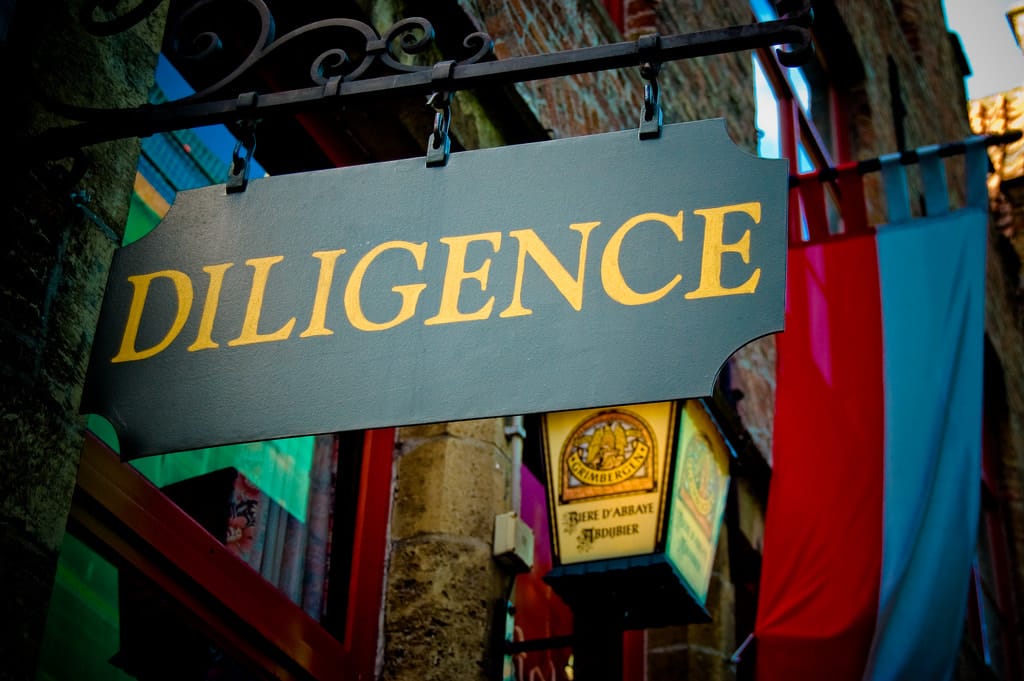
Conveniently, Malet's use of the phrase 'due diligence' offers me an opportunity to explain another example of a debating skill: testing the fallacy in an argument. And I mentioned a specific test in opening paragraph - a 'false analogy'. In short, this is where two concepts are presented as similar/connected, when they are in fact significantly different. One cannot 'hide behind' an act of due diligence - that is oxymoronic. As I explained within this context (article linked below), careful due diligence is by its very nature carried out in the open and in good faith, looking for evidence that may not be immediately transparent:
 Ursula Edgington
After initial concerns were raised, content from UKC inevitably developed more explicitly pro-China in stance, as explained in the previous articles I have mentioned above and also subsequently expanded upon by Iain Davis here. Along with other emerging evidence, these changes troubled me, so on 25 Nov 2025, I wrote:
Dear Charles, I do not want to be associated with UKC. So can your webmaster please remove my profile from your "Writers" section asap? I have archived the two articles UKC published elsewhere, so if you want to remove those too, no worries. Thank you in advance, Ursula
To which the director responded that as UK Column paid me, as a writer, for the two articles of mine that they published, they have no plans to take them, or my associated bio, down. To which I sent a reminder of the facts:
Actually, if you check your records, you (UKC) didn’t pay me. In the first instance, you paid [redacted]. And in the second, I waived the payment to ‘pay it forward’ for what I believed was a good cause. Please respect my wishes, Charles, and delete my profile from UKC. Thank you.
The following was my final correspondence with UKC, how apt that it is dated almost one year ago today: 27 Nov 2025:
Dear Ursula,
With apologies for the delay, thank you for reminding me about your considering UK Column to be a good cause.
After your original email came in, I took a look at some of what you have been writing recently, in order to consider what may have prompted your request, and this is what it looks like:
You are positioning yourself to make an open and collaborative attack on UK Column and, in particular, the individuals concerned with running it. In order to present yourself as a credible assassin, you would like to remove all trace of your association with the organisation, to avoid any blowback.
In effect, this process started earlier in the year, when you fell foul of the fiction put out by [redacted - at the time, an unknown author]. Rather than consider the facts, you have continued to speculate and to connive with others.
To that end, you are now openly attacking a member of the board of Akita Media. I would suggest that this is an unwise course of action, partly because you will be found out but mostly because it is so deficient of common decency. I do appreciate that some audiences have an insatiable appetite for gossip, as a means of distraction from all of the things they could be doing to position themselves against the real corruptions and tyrannies out there.
Since your actions so clearly telegraph your intent, I can confirm that there will be no change to the UK Column website, with regard to your contributions or your previous involvement with the organisation. If this really is the route you plan to go down, you must own the consequences.
It may be worth reminding you that nobody at UK Column bears you any ill will at all, and I am still at a complete loss as to why you have behaved like this.
When the exposé does hit the press, please be sure to reprint this email in full.
All the best, Charles
Charles Malet, UK Column
As you can see from the above, the author manages to (again) completely avoid engaging with anything related to the 'uncomfortable question' raised. Instead we read more (by now, very boring!) repeats of the examples of how debating techniques are subverted, using the strategies I have already outlined in detail above. Referring to the UKC subscribers' genuine concerns as 'gossip' is unfortunate - and disrespectful. I'm not sure why Charles Malet encouraged the publication of his correspondence with me, however although it was upsetting at the time, I'm sure you'll agree how these emails now serve a useful educational purpose.
As a Post Script, it's interesting to note that my articles and profile were eventually, recently deleted from the UKC website. Phew! Also deleted (apparently) were the community forums which probably contained more 'uncomfortable questions'?! Maybe UKC directors continue to use censorship when faced with unwelcome 'gossip' from their fee-paying subscribers?
Finally, in a very brief, but clear example of these tactics that seek to Dismiss, Deflect, Defame etc., comments by Jeremy Nell (an employee/contractor for UKC) on the Substack version of Iain Davis' article (that I already mentioned above), present more examples of these same strategies. Albeit in a much cruder format:
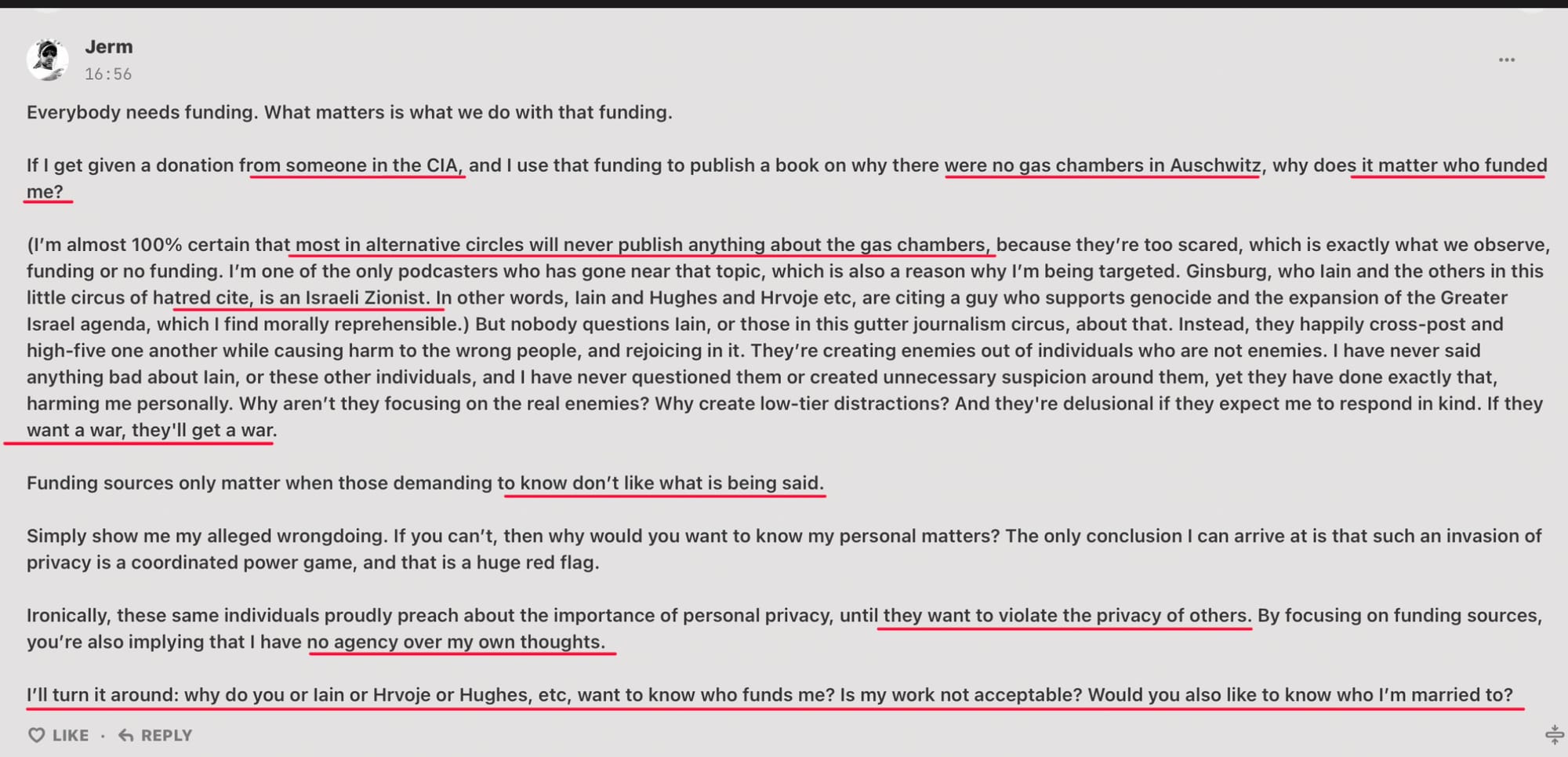
Notice in the opening sentence, the author refers to Nazi war crimes - a topic that could not be further away from the subject of the 'uncomfortable question'! He continues with a unfounded and offensive ad hominem attack upon independent researcher Michael Ginsburg, who is also asking the 'uncomfortable question'. The author then tries to deflect the question by trying to reframe it as a privacy matter. Again this is irrelevant; the simple question refers to a UK-registered commercial company, which claims to rely upon donations from its subscribers. Strange words indeed - until you realise what the intended purpose of these words might be?
Learning PsyOps Strategies - Stay Sharp!
There were many other similar, and even more offensive comments posted by Jeremy Nell on Iain's valuable article (I note that some of those comments have since been deleted). Was the intention to dissuade Iain (and others) from publishing any further 'uncomfortable questions'? If so, that goal is impossible. Many of us are older and wiser and have grown used to the propaganda tactics used against us - wherever and whoever uses them. Personally, I understand much better now, the true agenda and the diversity of (bad) actors.
Learning, identifying and analysing the propaganda strategies used by others when confronted with 'uncomfortable questions' provides good practice for getting savvy and overcoming the psyops used in this silent WW3. Do make a note of the five points of good debating skills, I listed at the start of this article, if you consider these useful. It is also helpful to see how these strategies can be used in reverse - carefully 'undone' - to help those deeply propagandised.
To make matters worse, in addition to the widespread use of these propaganda strategies, we now see AI learning from these kinds of toxic-but-human, online interactions. And AI can quickly hijack any conversation in unexpected ways. If you have personal experiences of these kinds of propaganda strategies being deployed, whether online or otherwise, on yourself or others - especially from 'Camp 2' entities - please share them below.
Thank you for reading and sharing... I appreciate your support!