
Fast-tracking Cancer Vaccines, AI & the PR Machinery of BigPharma

I couldn't have hoped for a better context to my (later than planned) article this week, than Sonia Poulton re-publishing her 'banned' 2019 documentary 'The Business of Cancer" (embedded below). If you haven't yet made time to watch this, I strong recommend it (1hr 10m). Today I'm fitting together some pieces of the 'cancer-vaccine' jigsaw puzzle. This draws on my previous work on my pet subject - the corruption of academia, in particular my case-study of Prof Angus Dalgleish and his work on 'cancer vaccines', the Public Private Philanthropathic Partnerships (PPPPs) that distort and harvest our personal data for experimental clinical trials of these 'vaccines' - and unexpectedly, I touch on ongoing concerns about the authenticity of alternative media.
In her usual no-nonsense way, Sonia summarises in her doco all the important aspects of what has become an international profitable industry in fundraising, diagnosing and treating cancer. I realise cancer is an emotive subject, and that is even more reason to investigate it. From the numerous 'non-profits' raising $million in funds for never-ending cancer research, the restricted laws controlling what people can/cannot say about cancer treatments, the capture of academia through what Sonia calls the behemoth 'CRUK' Cancer Research UK and the personal stories of patients who have been through the horrendous BigPharma interventions. And more...
Overall, we can see here the makings of the BigPharma capture of our regulators and the post-covid era of the jab-injuries that BigPharma now paradoxically claims to 'treat'. Seven years after this doco was originally published and then censored from YouTube, many of us now see how deep and dark this situation truly is.
My two-part case study about the self-proclaimed freedom-fighter who provides frequent red-faced appearances on Dr Nurse John's YouTube channel, illustrates clearly Sonia's points about the flawed research grant process when it comes to clinical trials. Like most academics, even though he's 'retired', Dalgleish's association with companies like Richmond Pharma where he is listed as an ‘expert’ worryingly boast about taking ‘assets’ (jabs?) from (AI) 'concept' to human trials in less 12 months. Eeeek! This 'race to market' (and therefore profit) is a constant theme, as I explain below.
 Ursula Edgington
 Ursula Edgington
To take one example of individuals within this machinery, Dr Nicola Allen is typical of a senior cancer healthcare professional in this arena. For instance, in 2020 she became a member of the Working Group at The Experimental Cancer Medicine Centres (ECMC) Network. The ECMC is jointly funded by, you guessed it, Cancer Research UK alongside the Little Princess Trust, the National Institute for Health and Care Research in England and the Departments of Health for Scotland, Wales and Northern Ireland. It works in partnership with entities like the MHRA, NHS Trusts and the universities that deliver the Pharma training:
Drawing on metadata from the NHS patients' records and other sources, the ECMC states it acts as a…
“…single point of entry to a UK-wide network of scientific and clinical experts to help deliver early-phase innovative trials, driving the development of cancer treatments of tomorrow. We have access to a pan-age patient population through our integration with the NHS. [In 2022] Cancer Research UK, the National Institute of Health Research in England and the Health Departments for Scotland, Wales and Northern Ireland invested over £100m in the ECMC network's research infrastructure to support the delivery of trials.”
What kind of 'trials' you may ask? According to the ECMC Network's Annual Accounts it is “a partnership with industry” namely Pfizer and Astra Zeneca - mainly recruiting and coordinating clinical trials for cancer patients’ experimental treatments, including 'vaccines' - similar to the interventions I explained in the above articles, that Prof Dalgleish is involved with. Perhaps unsurprisingly, Dr Allen has published academic papers about the practical and ethical challenges when pharma companies seek to speed-up clinical trials and strategies to overcome them. After all, regulators have now become enablers. For instance, one option she and her co-authors suggest, might be to change and shorten ‘endpoints’ of quality of life (QoL) measurements. Sounds ominous? The consequences of research outputs from these types of articles are extremely concerning, especially when, globally and in lockstep, end-of-life legislation is quickly being changed.
It's not only participants' clinical outcomes that are collected in these kinds of fast-tracked 'vaccine' trials. As Dr Allen et al's article explains, Real World Data (RWD) is often collected too, from unsuspecting participants, eg those wearing 'smart' watches, our social media posts and of course data input from you and your GP - like those in my investigations into the NZ data-harvesting tools MyIndici and Manage MyHealth.
Dr Allen is also employed as the Value and Access Policy Manager for the Assoc of British Pharma Industry (ABPI) - a large trade association you may already be familiar with? It represents the commercial interests of the UK pharma industry. It is funded by annual subscriptions from its hundreds of pharma-member companies that it (paradoxically) tries to impose 'codes of conduct' upon. The ABPIs lack of meaningful penalty after the recent Novo Nordisk Ozempic fraud has highlighted just how tokenistic this entity is. Here is an important clip from the ABPI and Assoc Medical Research Charities (AMRC) prophetic joint conference ten years ago in 2016 (10 mins):
Exec Director of CRUK (amongst other roles) Ms Burnard (CBE/MBE) from the BigPharma Boardroom who introduced this PPPP conference has since died, aged 57, in 2022. Her BigPharma colleague Mike Thompson said back then:
...a reflection ... on how our industry is structured and incentivized - if Coca-Cola had been allowed to charge 5o pence a can for 10 years and then had to make available their secret recipe to other generic manufacturers who would flood the market at five pence a can, I doubt that they would still be, after all these years, the largest soft drinks manufacturer in the world. In pharmaceuticals that's the challenge...
Maybe not such a bizarre analogy as this initially seems? After all, contrary to the 'Patient First' conference title, this gathering is actually about maximising profits for BigPharma share/stakeholders. Thompson goes on to predict how access to new genetic data about patients' DNA will provide 'more certainty' when facing a dilemma of choice about treatment options. A decade ago, informed consent was already being eroded (did it ever exist at all?).
Ms Burnard's background was in European BigChem/BigPharma PR, so I'm sure Sonia will agree it was predictable for her to join AMRC and CRUK. With her expertise and international networks I expect she was a valuable asset before her untimely death from bowel cancer.
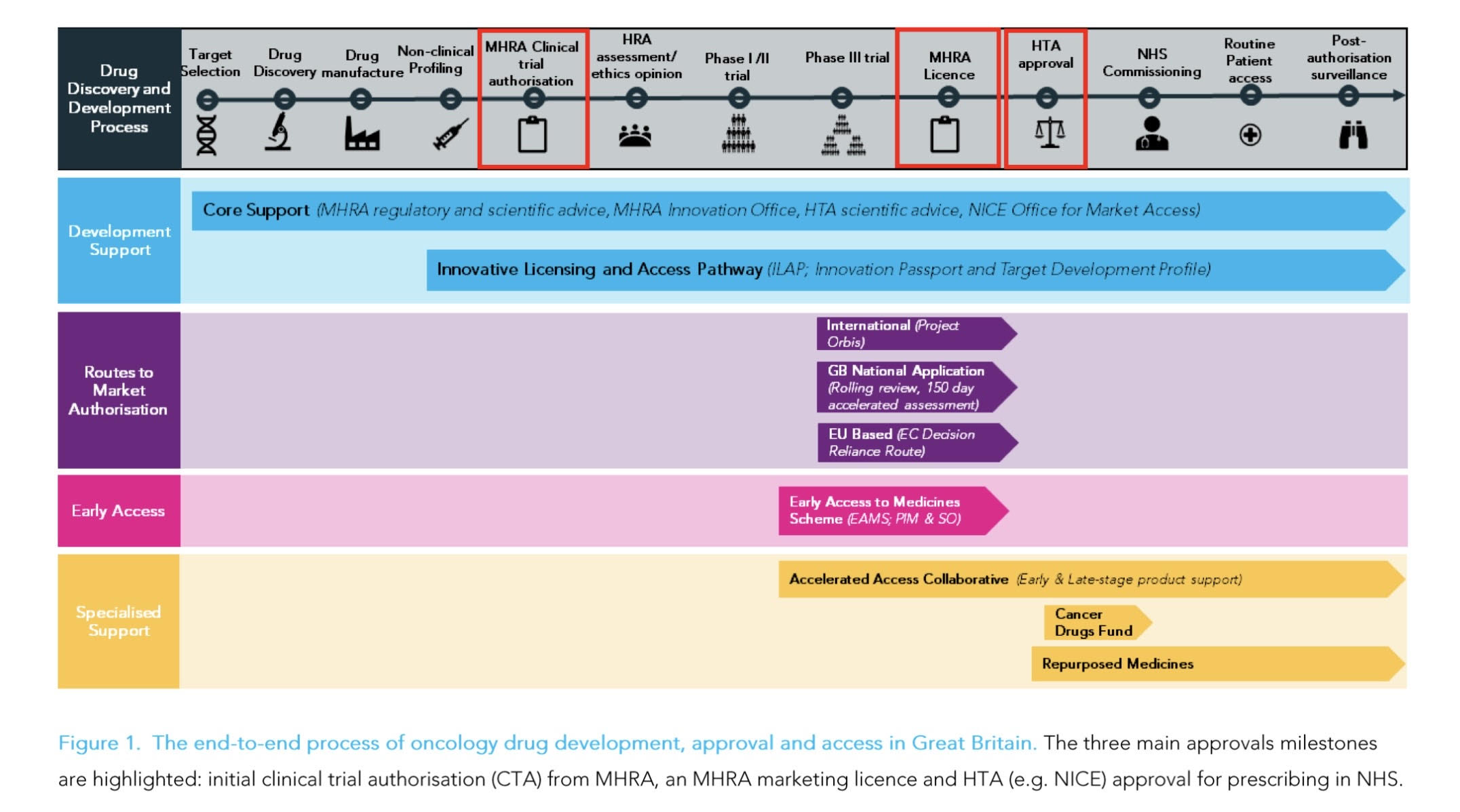
As for ABPI's Dr Allen, she was appointed to that special 'working group' for the ECMC during the time that Burnard was Executive Director of Policy and Public Affairs at CRUK. The result of that working group was mutually beneficial as in her April 2022 co-authored report "New Regulatory Routes for Cancer treatment in Britain" for the MHRA it proposed new fast-tracking of cancer treatments:
Strange how high-level PR executives like Burnard and her associated BigChem/BigPharma companies seem to be another constant theme of this ongoing research. I pointed this out last week when outlining the diverse professional roles of Prof Martin Cowie:
 Ursula Edgington
Purely coincidentally, Dr Allen and Prof Cowie have something in common. That's because in 2021 Dr Allen became Dr Allen-Delingpole when she married 'Charlie', James' youngest brother. (Prof Cowie is co-director of a luxury PR company where James' daughter apparently works).
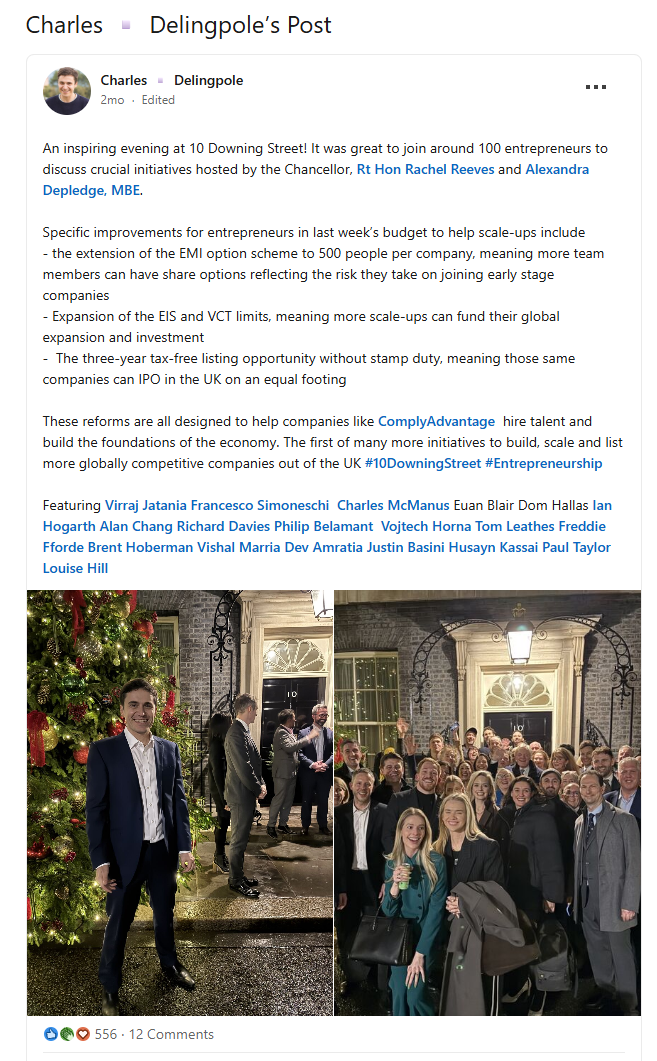
Interestingly, Charles Delingpole describes himself as an entrepreneur and technology leader. A graduate of Cambridge University (Social and Political Sciences), in 2002 Charles founded the 'world’s largest commercial student discussion forum' The Student Room Group. After a spell as a JP Morgan banker he turned angel investor and founded MarketInvoice (now MarketFinance/Kriya), an invoice/credit/finance platform. He’s also the founder and Executive Chairman of £multi-million Fintech firm ComplyAdvantage operated by IVXS Ltd - ‘An integrated platform... using AI to modernise financial crime risk management...’ Here he is talking at The City of London Corporation dinner that launched a 2023 report AI: Accelerating Innovation, How AI is Turbo Charging UK Financial and Professional Services (with EY) which describes the UK financial services sector's position in investing and adopting AI technologies. The title says it all. No doubt BigPharma's 'turbo-charged' vaccine development (for turbo-cancer?) is front and centre of these impact investors.
I'm sure high-end PR and AI Fintech companies with BigPharma and Government connections could be useful in this Technocratic Dark State? Especially when outcomes from genetic vaccines in clinical trials travelling at the Speed-of-Science need to be rushed to a profitable market? This is such a tangled web...