
Who are these Fake Fact-Checkers? The University of Canberra's News & Media Centre
A Case-Study from Australia in how the public is manipulated by 'trusted news sources'
My colleague brought a new Oz publication to my attention that was reported in The Conversation with an intriguing claim:
“97% of Australians have limited skills to verify information online”
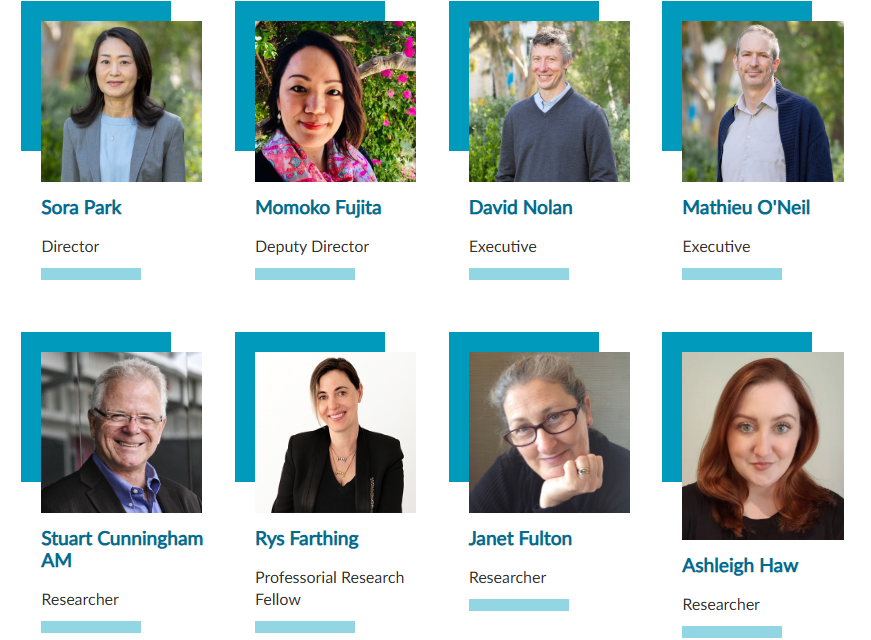
The author of this nauseating piece of propaganda, is Joel Abrams. He also wrote this patronising piece of bs called “A recipe for trustworthy journalism” which included this not-to-be-missed video (1m 40 secs) where a woman in a kitchen tries to promote the metaphor of cooking-up a ‘news’ article by dumbing-down its ingredients:
I don’t expect Joel will be reading this article, but I wonder whether he actually took the time to read the University of Canberra’s report (NB NOT a peer-reviewed article) about social media literacy, before writing about it? Or, was this another example of a simple ‘copy and paste’ from a PPP’s media release?
I’ve published a few articles about how academia is broken, corrupt and captured. For instance this one where I explained how Universities Control the Narrative when research outcomes don’t toe the line for GloboCap.
Early in 2024 I wrote (link below) about the University of Canberra’s capture by the Google News Initiative, primarily through its Comms Dept, the ‘News and Media Research Centre’ (NMRC). Which isn’t a ‘research’ centre in the true meaning of the word - it’s a PR machine, as I explain below. One of this entity’s primary objectives seems to be rebranding Wikipedia as a ‘Single Source of Truth’ to a new generation.
 Ursula Edgington
The News and Media Research Centre (N&MRC), based within the Faculty of Arts and Design, advances public understanding of the changing media environment and advocates for a media system that builds trust, inclusivity, and diversity. The Centre is nationally recognised for its research areas of expertise, which include: News audiences and consumption; Misinformation and media literacy; Indigenous media; Health communication; and News and media policy.
And this latest report, published Dec 3rd 2024, has a similar focus to past outputs. But the public have known for decades how unreliable Wikipedia is - after all, it’s primary function was to be responsive to citizen-editing. Even if you haven’t been keeping up-to-date with how Wikipedia has been captured by GloboCap, you’ll have noticed how biased it’s become over the covid era. For more detail, here’s an excellent summary of an interview with its original creator, Larry Sanger.
 Guy Ginton
How valid is this claim that 97% of Australians have limited skills to verify information online? Let’s unpack what that might mean exactly…
- First, (and I get so bored of writing this when peer-reviewing research) where is the authors’ theoretical framework? Interpreting responses from the public, using language that is deliberately ambiguous, means that from the outset, the reader needs to know ‘where the author is coming from’ with their questions. In this case, what do the words ‘verify information online’ even mean? How is that measured, defined? Why? And by whom?
- Secondly, the questions in the survey are leading, and in some cases are just illogical. Let’s take one example that Joel used in his The Conversation article, (we don’t even need to read the whole report at the University of Canberra’s website). We’re provided with this screenshot (below) of a Facebook post by Lyle Shelton, an Australian politician, who incidentally seems to be standing up against the sick Transgender Agenda (is that why they targetted him?):
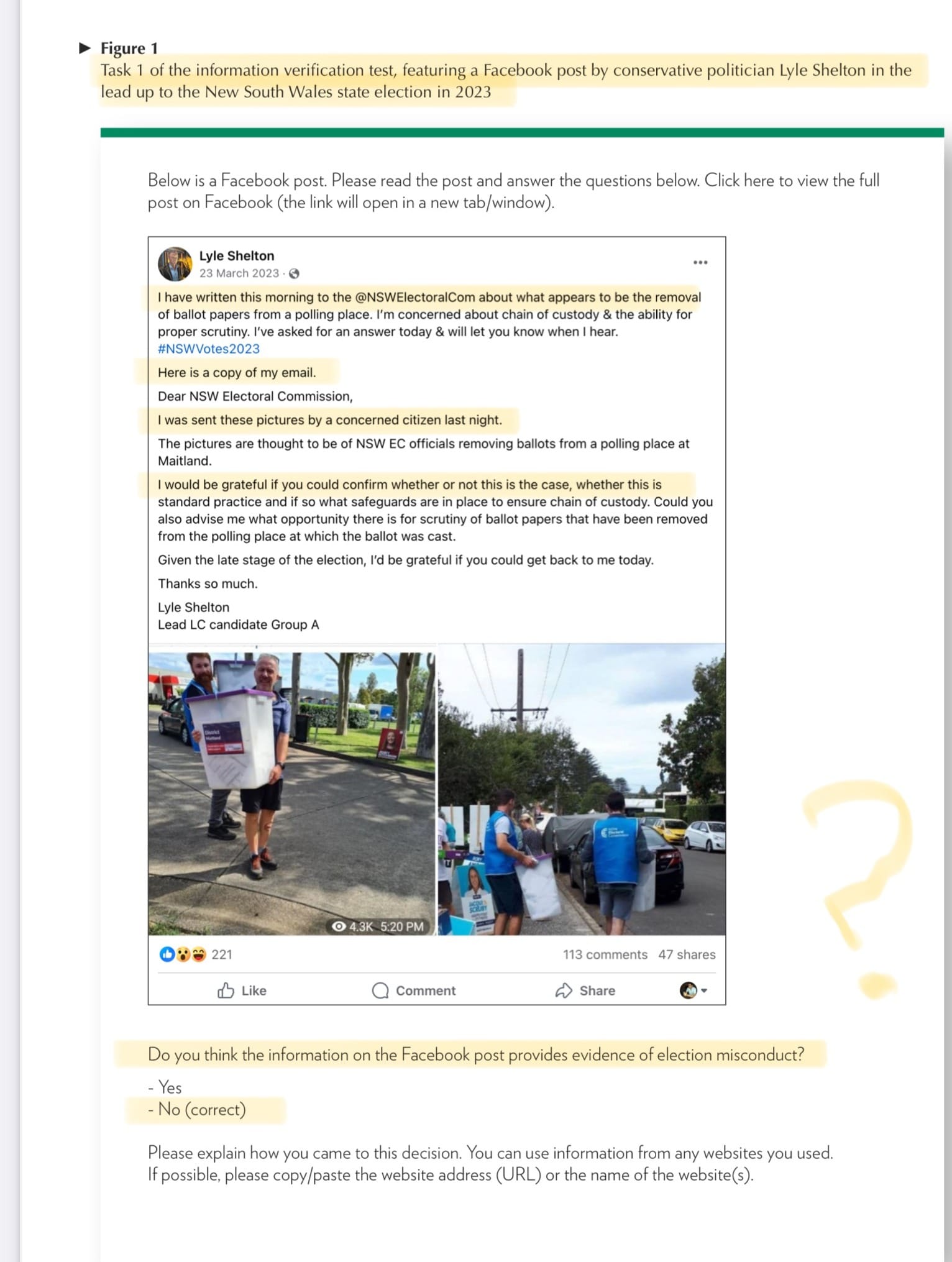
Lyle explains in this 2023 post - very clearly - that he has written to the New South Wales Electoral Commission about some suspicious activities he had been informed about, that could highlight invalid chain of custody procedures. Crucially, participants reading the survey are not informed what the outcomes from this letter were (but some may know if they lived in the NSW area).
Legitimate questions to the participants when trying to gain insights into their media literacy, could be about the images/words of the fb post itself, or perhaps whether Lyle Shelton was being impersonated. But instead, obscurely, the survey asks (highlighted in the screenshot above)…
- Q: Do you think the information on the Facebook post provides evidence of election misconduct? Yes/No
Provides evidence?! Eh? The scoring of these answers meant there was no room for comments or feedback - the NMRC deemed ‘No’ to be only correct answer. But to anyone who can read, that obviously wasn’t the point of Lyle’s post - he simply published an email to the NSW Electoral Commission asking whether these images were of ballots being removed from a polling station…. (Do comment below if you know the outcomes from this, I’m curious!)
Mistakes were NOT Made
Professional researchers do not deliberately present a question that bears no relevance to the image under scrutiny. That just wastes time and money and resources. It undermines credibility. Questions in any survey must be tested rigorously, (and piloted) and usually presented to the University’s Ethics Committee. But in this case, it didn’t matter. The outcomes were only positive if participants dismissed any potential critique of election fraud as ‘conspiracy theory’ - especially from a name that was a known ‘dissident’.
In another task, participants were asked about two different websites (about wind turbines), and comment on their '“credibility and authenticity”.
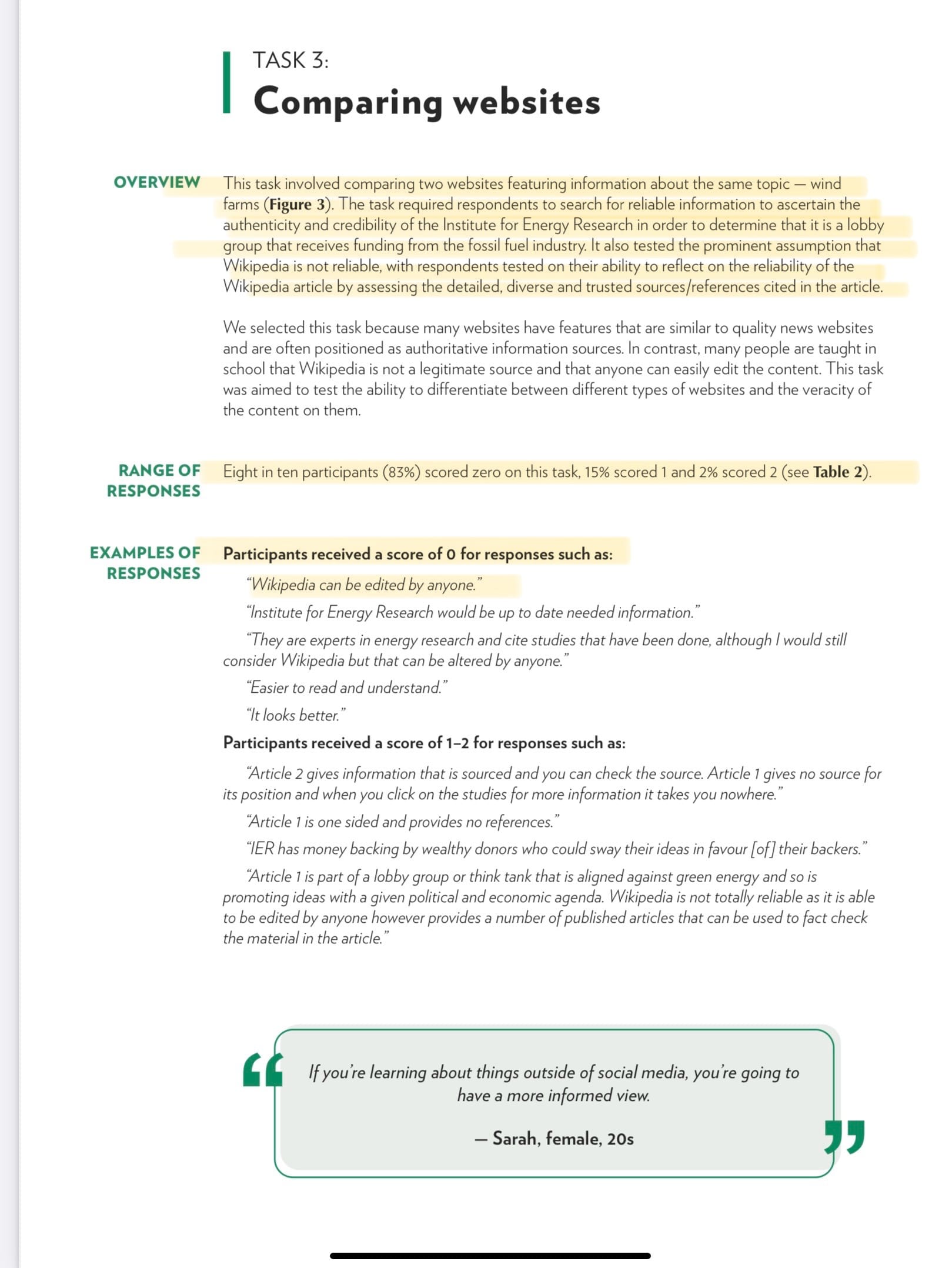
Notice how the statistics are skewed - percentages are used, where none are valid. And once again, we see the reference to Wikipedia, and the authors ambiguously try to claim that Wikipedia is somehow legitimate as a source of reliable information. We can see how one participant, having stated the obvious truth that “Wikipedia can be edited by anyone” scores zero in this assessment. Whereas someone who claims that ‘published articles’ cited in Wikipedia (even though they probably haven’t read them) scores 1 or 2 points.
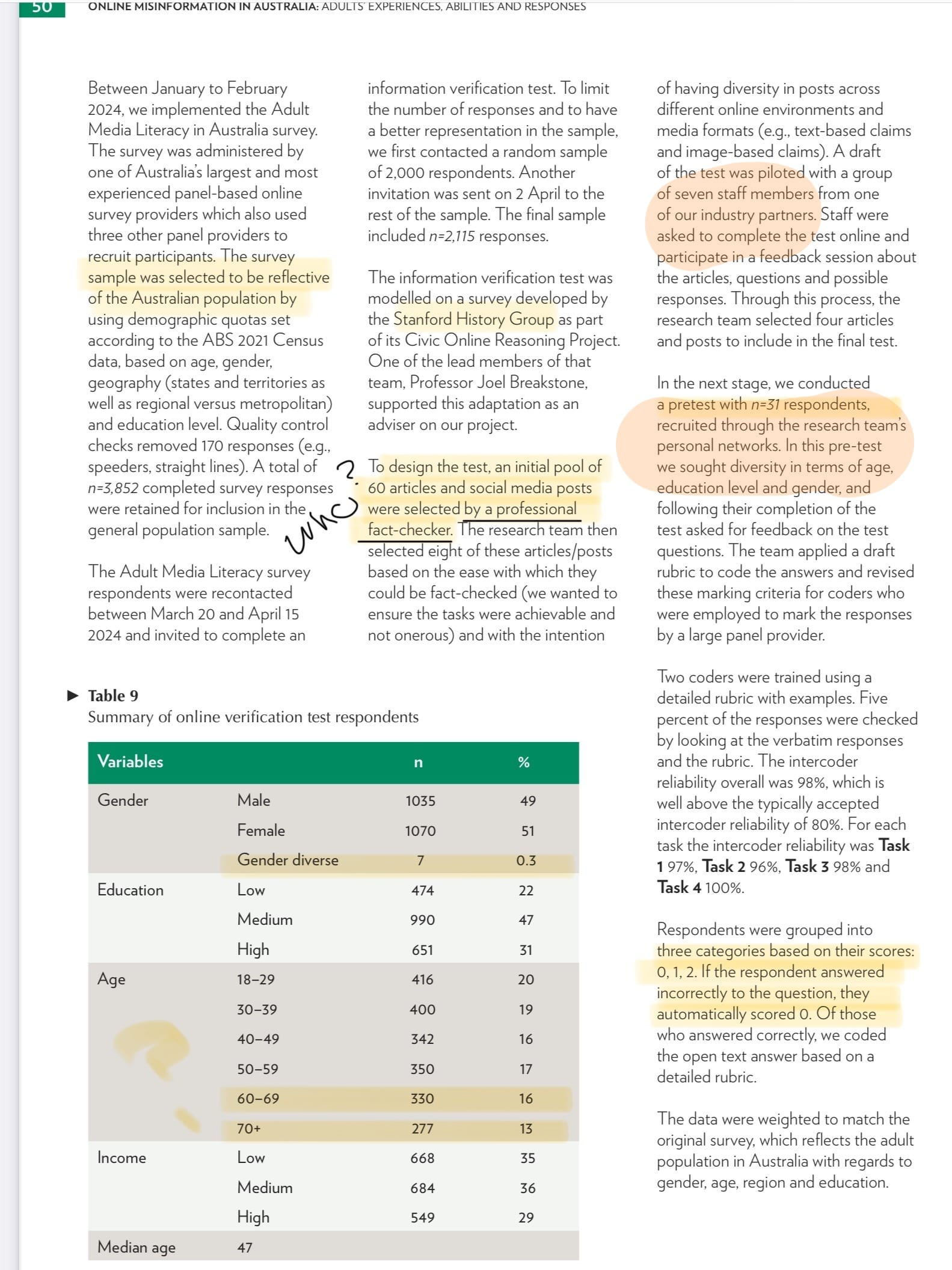
The survey questions were all based on social media posts that were ‘carefully selected’ by a ‘professional fact-checker’. Oh really? From ‘industry partners’ perhaps?
Although ~2000 participants answered the (flawed) survey, only 55 kept journals that were used as follow-up materials. 31 participants did a ‘pre-test’. And then only 20 people were interviewed for more detailed information. Where did these participants come from? They were apparently from the researchers’ personal networks. I kid you not. And looking below at the respondents, do these look like ‘representative of the Australian population’ to you?
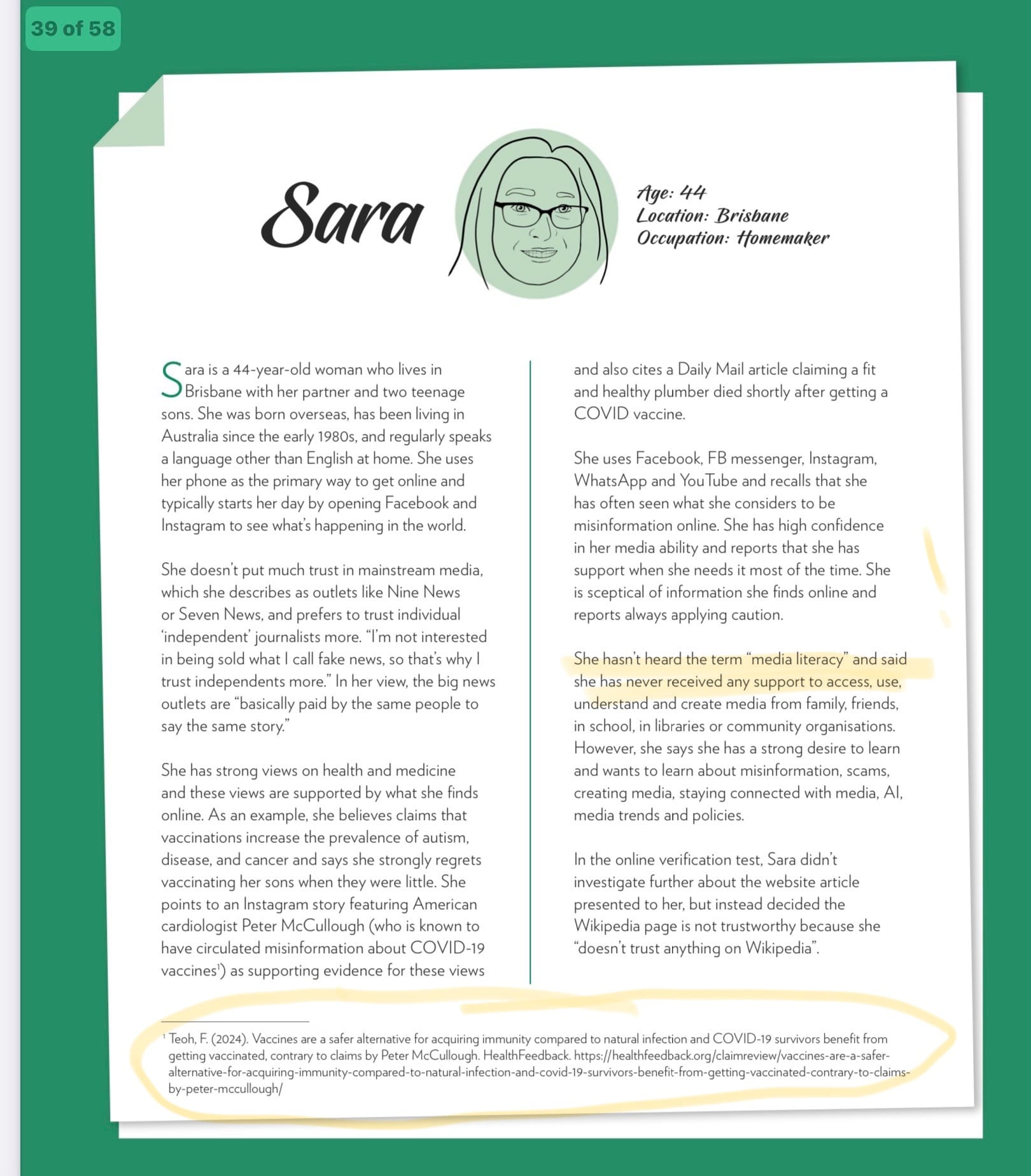
Throughout the report are short patronising ‘profiles’ of participants, based on the authors’ interpretations of responses. Here is ‘Sara’ who, aged 44, apparently did not understand what is meant by the term ‘media literacy’ - the authors deemed that to mean that she was not media literate! The profile illustrates Sara should have known better than to post an article by Dr Peter McCullough with evidence of cardiac problems post-injection, and a Daily Mail article about the death of Kiwi Rory Nairn who was confirmed by the Coroner to have died from myocarditis following a Pfizer covid mRNA injection. This was all entirely misinformation, according to the University of Canberra’s NMRC…
And while we’re on the topic of misinformation, it was interesting to note the reference to this word in the report. The authors’ footnote (2) says mis- and disinformation are the same, with no mention of mal-information. Maybe the authors could brush-up on their own vocabulary of ‘media literacy’? These facts, together with citations to the WEF and the UN and references to democratic processes, you get the gist of what this is about:
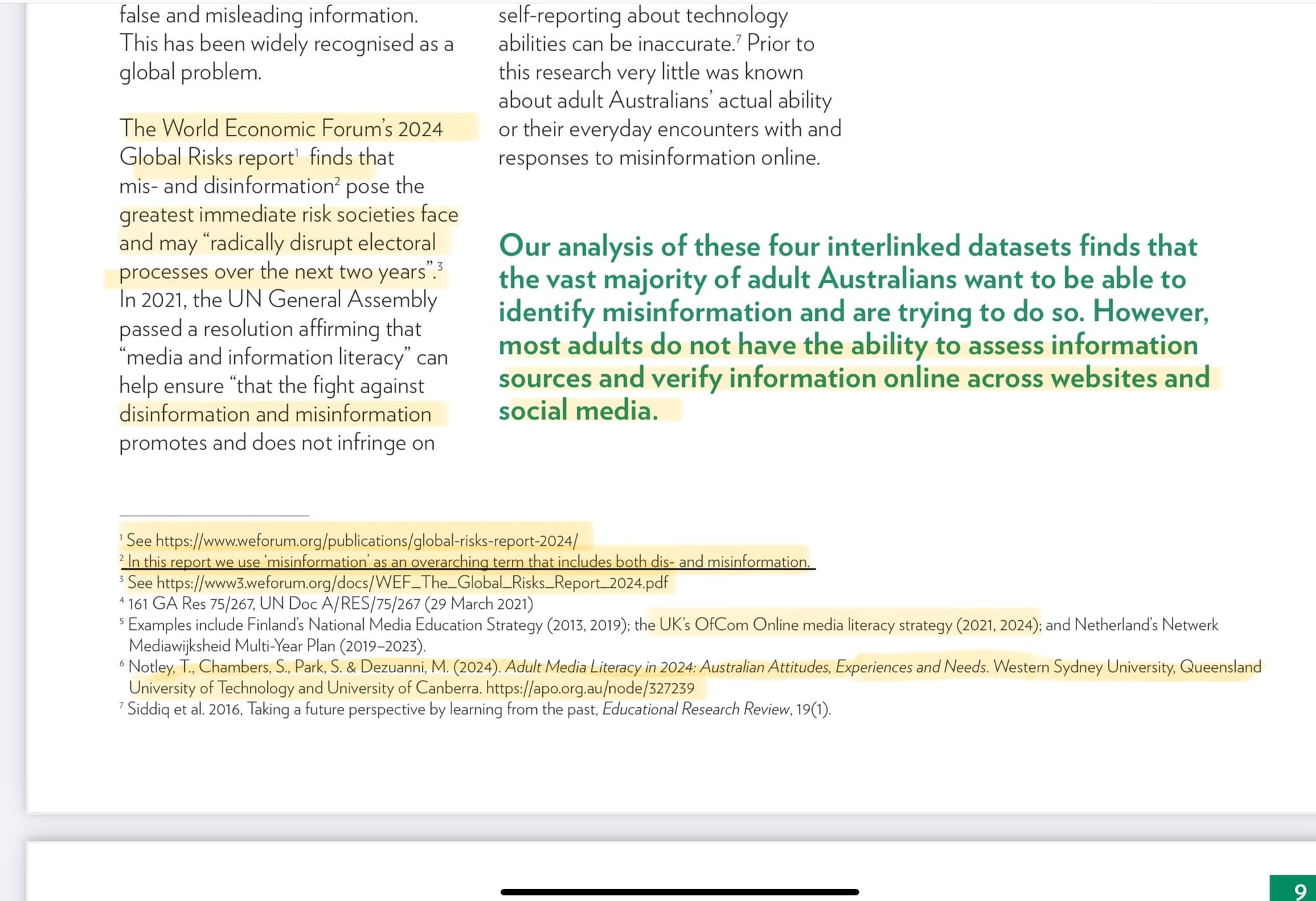
In conclusion, I want to add the names of those leading the NMRC and apparently deliberately misleading the public with this report that Joel Abrams has presented to The Conversation’s audience. Their current Director Sora Park (updated) and Deputy Momoku Fujita. Many of the staff have had, or are continue to have, roles in the Legacy Media that they try to defend, like ABC. And grants from the Australian Research Council (ARC) also feature prominently in their profiles. The NMRC itself - as I evidenced in my previous article (hyperlinked at the top) - is funded by Google and other GloboCap entities.
The Fake Fact-Checkers are the academics that work for institutions claiming to be the Critic and Conscience of Society. We have reached the Ministry of Truth. I’m not sure these pseudo-researchers are even aware of how propagandised they have become. (update: I never received a response to my request to comment from their previous Director, will I receive one from Park?)