
MPs On Record that Pfizer's NZ Provisional Approval was Illegal in May 2021
Lawfare under the microscope: how US Emergency Use Authorization (EUA) was suddenly, unethically and undemocratically adopted by NZ Parliament
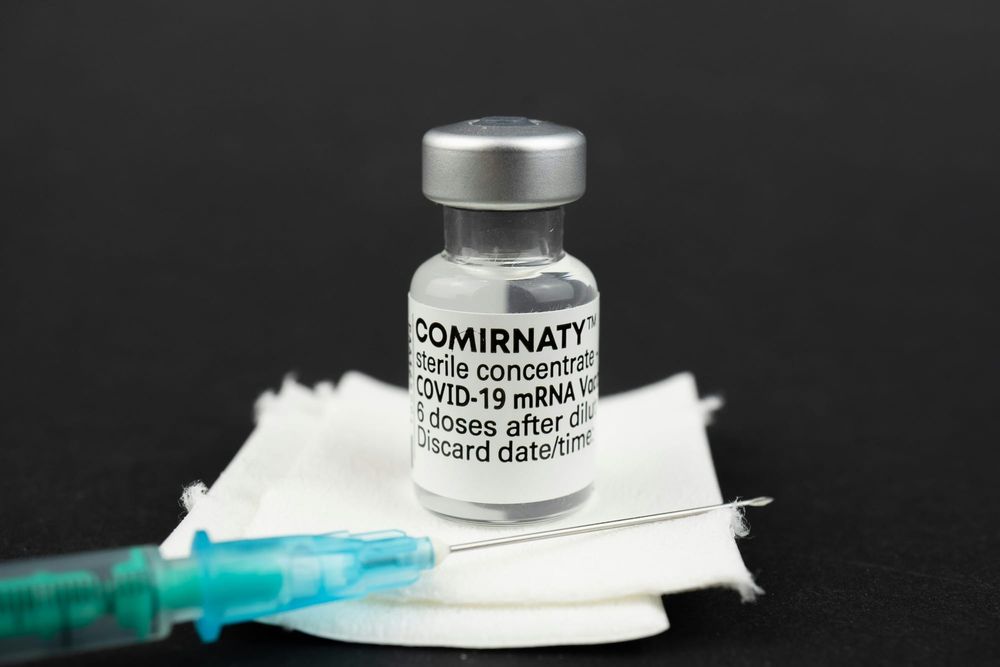
“I’ve got to say it’s the most fantastic time to be alive. Thanks to the twin miracles of capitalism and science, the same company that gave us Viagra has now given us a vaccine that will end this epidemic. What a time to be alive!” David Seymour MP/Leader for ACT, May 21st 2021.
“…we find ourselves in this situation because, as compared to other countries, we don’t have an EUA, an emergency use application, which the US and, certainly, the UK and other countries have. So we’ve had to rely on a section 23, provisional consent.” Shane Reti MP
These quotes were from a debate under ‘Urgency’ in our NZ Parliament: “The purpose of this bill is to increase patients' access to medicines by reducing some of the barriers to access currently in the Medicines Act 1981.” There have inevitably been subsequent changes to this legislation, but rather than getting bogged-down, I want to bring readers’ attention to something specific from Hansard 21 May 2021 which, as MP David Parker explains:
“…changes the provisional regime to remove the “limited number of patients” part of the rules relating to a provisional approval. It does that not just in respect of the COVID vaccine, but in respect of the other medicines that are listed in Schedule 1AA, which include the annual influenza jab that is widely used and has been approved under this methodology for many, many years, under successive Governments.”
Then, Chris Bishop (National) MP explained (pg 2797):
“The reason why we’re debating it, of course, is the decision of Her Honour Justice Ellis delivered yesterday in the High Court in relation to relief sought by applicants essentially trying to stop the roll-out of the COVID-19 vaccine. Members may want to refer to paragraph 75 of the judgment [conclusion], which is, I think, the key one, which is the paragraph in which Her Honour notes that it is “reasonably arguable”, her words, that provisional consent granted to the Pfizer vaccine was ultra vires the Medicines Act 1981.”
The judgment Bishop was referring to was this one ‘Nga Kaitiaki Tuku IHO Medical Action Society Inc v Minister of Health and others [2021] NZHC 1107 [18 May 2021]’ in which Justice Ellis stated:
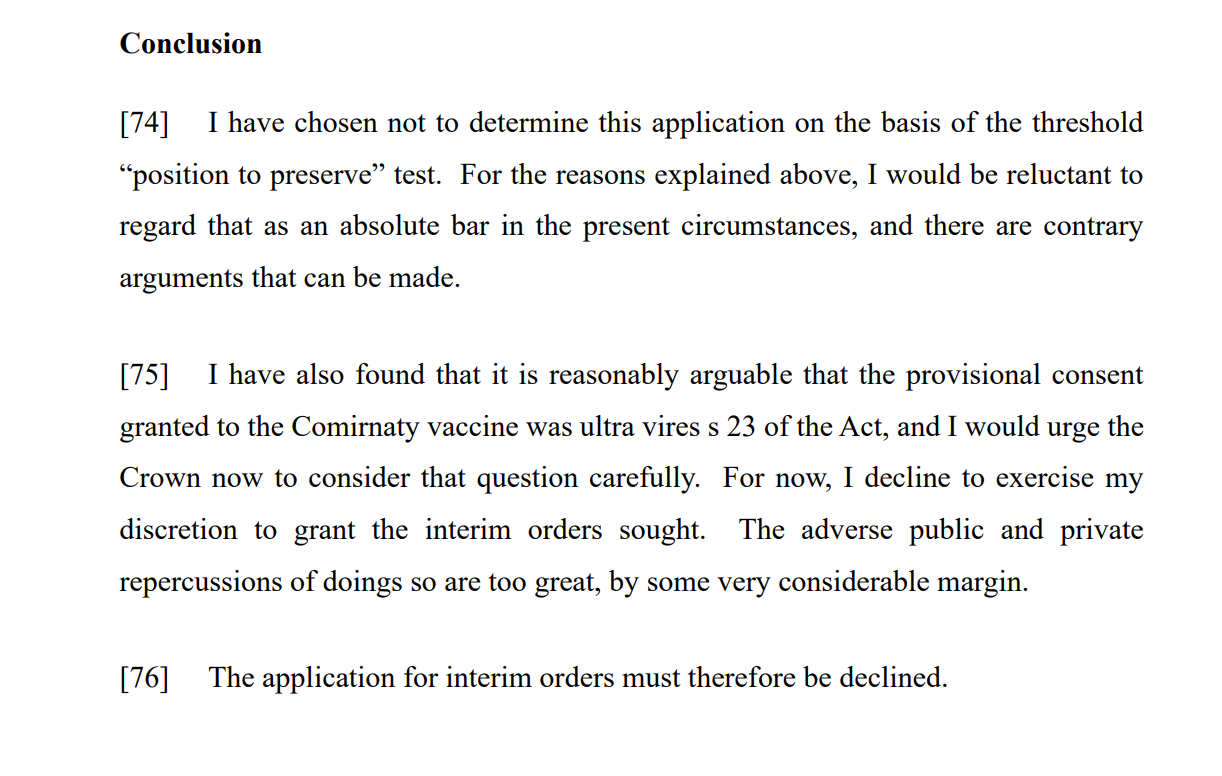
For those unfamiliar with legalese, ultra vires means ‘outside the powers’. In other words, the dispute before the High Court (i.e. whether the ‘provisional’ approval for the Pfizer covid injections was valid) was outside the scope of the existing piece of legislation (in this case, the Medicines Act). The Government needed to reflect on that.
In para 60, Judge Rebecca Ellis clarifies her position:
“For better or worse, the additional s 23(1) requirement—that the Minister must be “of the opinion that it is desirable that the medicine be sold, supplied, or used on a restricted basis for the treatment of a limited number of patients”—is consistent with the underlying premise that the new medicine’s safety and efficacy has not been fully tested. It seems unlikely that this requirement would be empty, and the words are not complicated.” (my emphasis) …and goes on in para 66 to specify:
“In my view it is reasonably arguable that the decision to provisionally approve the vaccine for much wider use is problematic. If the interpretation I have articulated above is right, then s 23 does not contemplate the grant of provisional consent for a new medicine that will, before the end of the year, be made available to treat the three and a half million New Zealanders who are over the age of 16.” (my emphasis)
Like so many of these judicial decisions during covid (and now) the Judges constantly contradict themselves. After clearly stating that the legal processes were not adhered to, that this legislation does not support the authorisation and that there are numerous problems with these policies, she goes on to make (quite frankly, pathetic) excuses for ruling in favour of the continued roll-out (I’ll paraphrase):
- There would be a ‘risk’ to public health - (“because, Covid”)
- Many people have already had one dose - so halting it would mean logistical problems and additional costs
- The injections will reach their expiry date (!)
- We would ‘be forced’ to go back into lockdown (!)
- Public trust and confidence would be eroded
- Pacifica peoples also need (our excess) injections
Why does Ellis not dare to make a judgment that contradicts the Government’s existing, illegal policy decision about the jab roll-out? Well, as I have explained at length before, NZ lawyers are in bed with our Government, with $millions funded to Large Law Firms NZ Ltd by our tax-paid dollars every year. Justice Ellis is no exception to those revolving doors of power:
“…[Ellis was] senior litigation solicitor at Chapman Tripp* in Wellington from 1992 to 1996. In 1996 Justice Ellis joined the Crown Law Office and was employed as Crown Counsel in that office until her appointment as Director, Legal Services at the Ministry of Economic Development in 2004. In 2005 Justice Ellis re-joined Crown Law. In 2006 she became a Team Leader of Crown Law’s Tax and Commercial Team and during 2008-2009 she was Manager of the Crown’s Structured Finance Litigation. Justice Ellis was appointed a Judge of the High Court in 2009.” (My emphasis. source) *NB part of Large Law Firms NZ Ltd
In any ‘normal’ situation, the Hansard, 21 May, would have included the many reasons WHY the legislation meant that any provisional approval of a new medicine should only be for a ‘limited number of people’. Eg likely a risk mitigation for people with a particular (high) risk of a disease, or individuals who were likely to die anyway, as a result of lack of (other) treatment options. Yet issues of safety and informed consent are bafflingly completely absent. Even basic critiques of ideological views between different political parties was missing. Instead, MPs just wanted to know why the law wasn’t already changed BEFORE the roll-out, not in retrospect. For instance, MP Chris Bishop goes onto say:
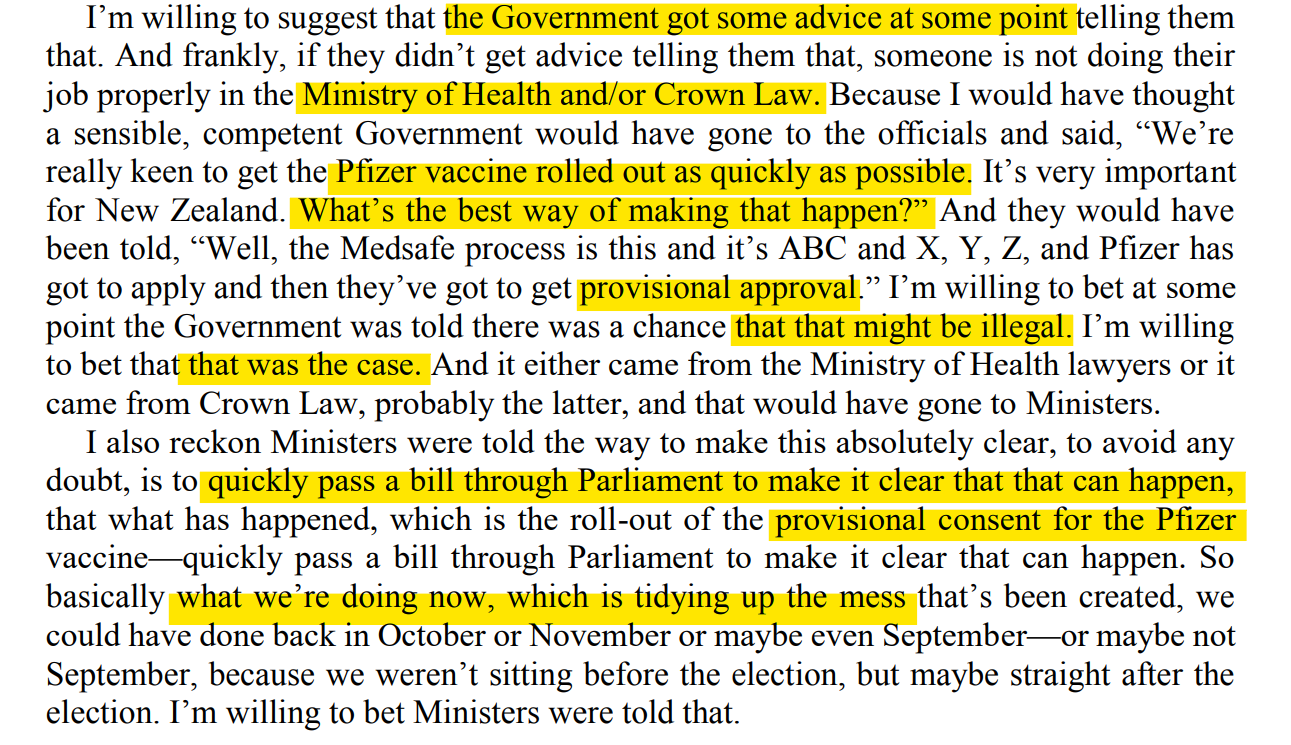
Bishop then goes onto ask whether legal privilege can/should be waived so that we can access the legal advice provided to Government about this topic:
“I want to know from the Government what they were told and I want to know when they were told. And I would encourage the Government in relation to its legal advice to waive privilege if required, because it’s in the public interest that I think we know that. I’ve asked the Minister for COVID-19 Response for the legal advice in relation to this, and he’s declined to give that to me on the grounds of legal professional privilege. That’s the Government’s right, but it’s also up to the Government to waive that privilege. I see the Attorney-General is here and I’d encourage the Attorney-General to waive that privilege. We need some answers from the Government.” (my emphasis)
I’ve written before about the issue of NZ lawyers professional legal privilege in relation to things like the Pfizer contracts, here. However, MP David Parker then stated:
“Ministers were not provided with that advice as to the issue that the member seems to think that we were alert to earlier; we weren’t. This first came to the attention of the Government upon the filing of the court proceedings, not before…”
Curious. We’ll come to what that actual (late) legal advice was, in a moment. Meanwhile….Julie Anne Genter (Green MP) was clearly deep into the mass formation, repeating the BigPharma fear-mongering propaganda at length, to emphasise how ‘lethally dangerous’ covid was:
“Any potential negative side-effects that have been observed with the vaccine are minuscule and tiny compared to the illness itself, and so we are far better off getting this vaccine, and we’re quite lucky to be in this situation, to be in a country that has been safe from COVID-19 for most of the past year. […] There are some countries in the world that desperately need this vaccine, and they’re not getting it…” (my emphasis)
Self-respect, duty to their electorates, support and respect for citizens’ rights all seemed to fly out of the Beehive’s windows...
David Seymour went on to say in that May 2021 debate that our country’s sovereignty was basically worthless, and we should ditch Medsafe altogether in favour of just trusting The Science™ from overseas (pg 2805):
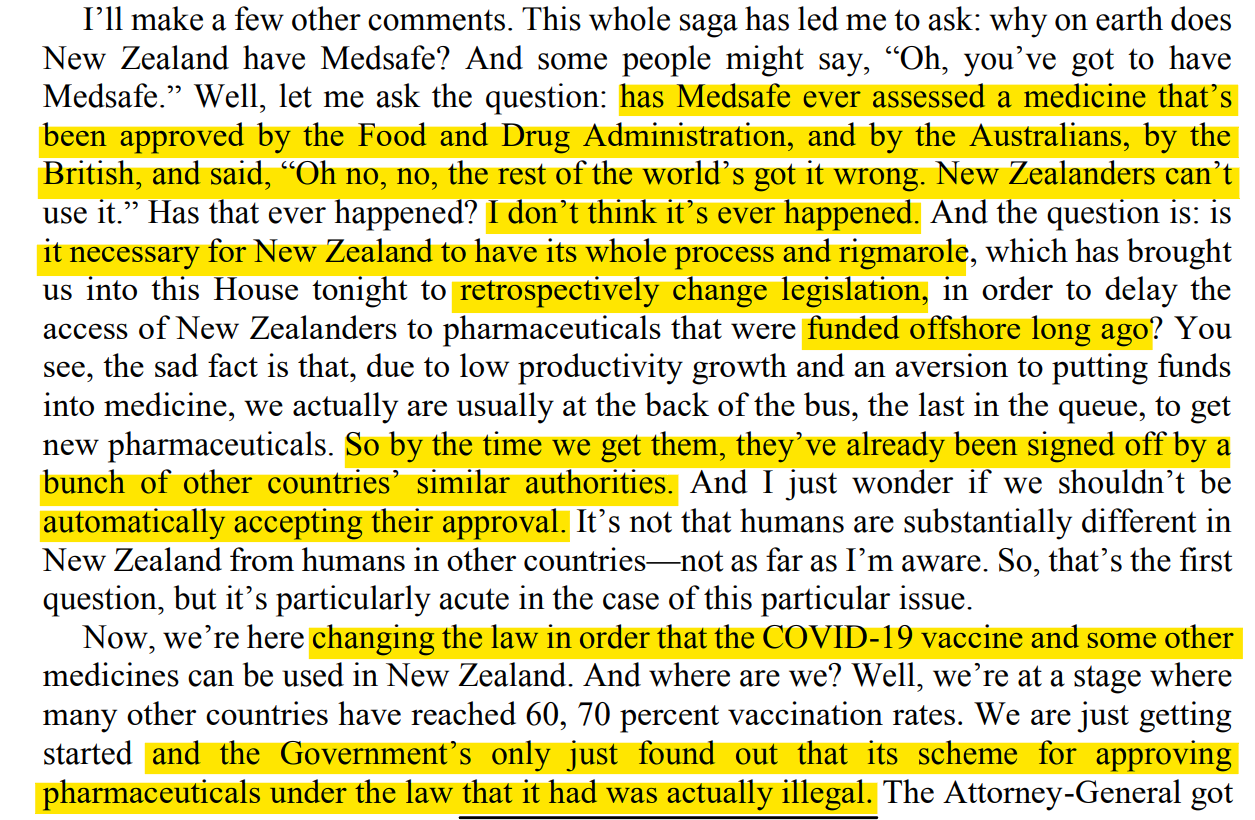
He goes on to refer to the judgment that I highlighted above:
“And yet now we also find out the Ministers didn’t even think, “Hey, this big strategy we’ve got, is it even legal?” No, and so, of course, people went off to court, tested their rights, and now we’re here in Parliament retrospectively changing the law.”
So we did test our rights. The Judge confirmed we were correct. And MP Nick Smith seemed to sense that this overreach was setting a dangerous precedent:
“We have an unusual situation where we have a court ruling and we have the Government using the powers of this Parliament to overrule that court process. In many instances that I have seen Parliament do this, often it’s said that you would allow the benefit of the individual that’s taken the court action to get the benefit of that, and that is just unconscionable in the public health situation that we have in the world and in New Zealand, and that is why National is choosing to be so cooperative in what is a pretty extraordinary exercise of parliamentary power to override the decision of the court.”

There was no mention of the reporting of adverse events from the injections, this seemed completely outside the realms of possibility to all the MPs discussing the Amendment to the Bill. However, the safety of the jab was briefly referred to by MP Michael Woodhouse (he’s since left politics to become CEO of a private hospital in Christchurch):
“clearly the authorities believed that a provisional consent wasn’t sufficient to satisfy all of the questions that it had regarding—certainly—efficacy, because, of course, with the vaccine roll-out, one wouldn’t know the efficacy of the vaccine until the end of the product. But it also talked in the court judgment that Pfizer were also asked to continue to provide other information, including that around safety.”
MP Nick Smith reiterated the seriousness of the debate:
“I want to remind the committee that we are overruling a court decision. We’re applying this law retrospectively. It is an issue that goes to the heart of the biggest issue that New Zealand has faced in many years: that there is a high expectation of a level of competency within Government. So we do require an answer to: how was it possible for a Government to be so incompetent to believe that it could approve a vaccine when the provision on which it was approving it explicitly said that it could only be used for “a limited number of patients”? That question needs to be answered by the Government.”
Indeed. It does. And here is that Legal Advice I referred to earlier, received by the then Attorney-General David Parker, which states, paradoxically, how the lifting of the restriction of ‘limited number of people’ from s23 in the Medicines Amendment Bill, does NOT constitute a breach of s10 of our NZ Bill of Rights Act. Because - get this - an ‘experimental’ medicine is NOT ‘experimentation’ IF there is ‘no plan to gather new or additional info on the ‘thing’ (medicine). (see below):
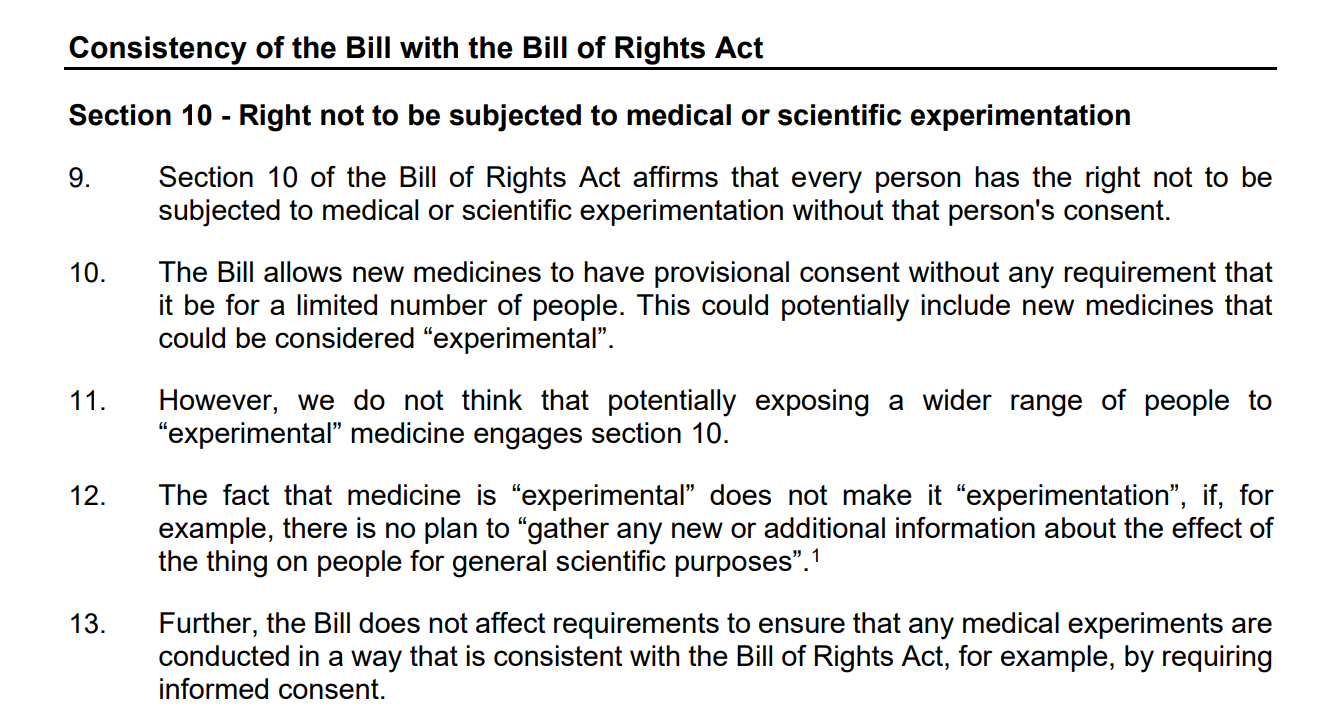
So is point (12) above referring to the common clauses within the Pfizer contracts (as I discussed here) that prevent any negative reporting of the impact from the injections? Is that why Health Forum NZ and other advocacy groups for the jab injured are (still) censored and gaslit by the authorities? It’s confusing to see that the author Jeff Orr, Chief Legal Counsel for the Crown, cited caselaw (‘1’ at the end of point 12 above), referring to something every New Zealander should know about - Taunoa v Attorney-General (2004) (Wikipedia) full judgment here 7 HRNZ (HC).
In this case of cruel and unusual punishment at Auckland Prison, inmates were subjected to months or years of horrendous acts of inhumane treatment by the ‘Corrections Officers’. They were kept in isolation, in small bare cells without windows for 23 hours a day, had basic essentials like clothes, bedding and toilet paper withheld from them, and prohibited from accessing TV, books or anything to alleviate their fear and boredom. Needless to say, the prisoners’ poor mental and physical health seriously deteriorated as a result of the evil regime.
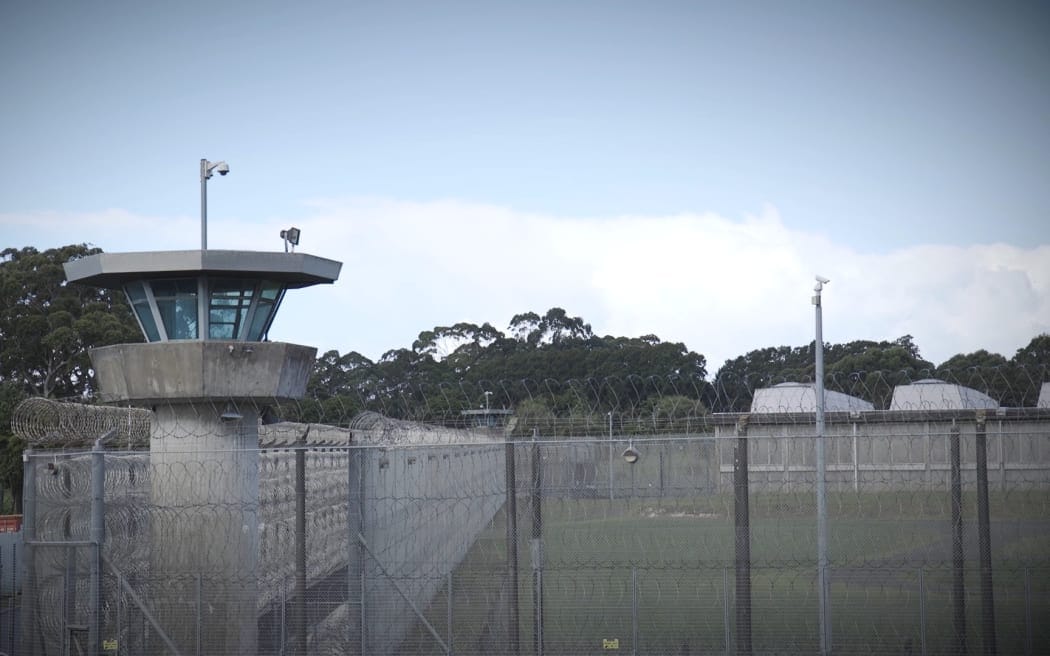
As a volunteer tutor who has worked ‘behind the wire’ (before being mandated out), my heart breaks to read these stories of human rights abuses.
But even more concerning and quite honestly disgustingly, this Legal Advice to our Government (May 2021) was not referring to the obvious Human Rights abuses in that historic judgment, but the cold-hearted attempts at calculating financial compensation for the cruelty prisoners had suffered. Was that because, rather than considering carefully Human Rights obligations, alongside valid informed consent for the experimental injections, that all these lawyers were focused on, was the potential costs if found out? Who were the lawyers on Orr’s team back then?
Conclusions
- One of the main criteria for the NZ Provisional Approval provided to Pfizer’s covid mRNA injections was for a ‘limited numbers of individuals’.
- Clearly, this was never the case because by then (May 2021) it had already been rolled-out to a global population, including many New Zealanders from Feb 2021.
- It was the result of the KTI Court Case, and the subsequent pro-narrative Government-supportive judgment, that alerted our MPs to their totalitarian over-reach in this illegal approval.
- As a matter of urgency, within a week of the contradictory judgment, MPs changed the law with unusual retrospective effect, eliminating the inconvenient words, so that the roll-out could continue unhindered by further court action.
*With thanks to and a certain subscriber for bringing this info together for us all to analyse and share.