
Due Diligence is a Waste of Time [not]
![Due Diligence is a Waste of Time [not]](https://cdn.mymidnight.blog/970af30e481057c48f87e101b61e6994/size/w1000/2026/03/Bilal_Basrai_The_Necessary_Steps_To_Conducting_Du_-166379193-.jpeg)
Irony is a useful tool in writing. It can pull attention to the truth, through obvious UNtruths.
We seek out alternative, independent content-creators because they pursue and report truth. But isn't it ironic that whilst legacy media and charities can be held to account through published financials, most independents are private and avoid public transparency? With this in mind, some of my seemingly diverse articles share a common theme: how and why are alternative, 'independent' platforms captured, exploited, demolished or hijacked?
As Hrvoje Morić of Geopolitics & Empire states in his meticulously-researched recent article Multipolarity as World Government 3.0 & its Pied Pipers we live in a world where factcheckers peddle propaganda and lies are claimed to be truth. No wonder "You're controlled opposition!" may be a common gibe nowadays, but that's why a consideration of the opposite of someone's claims, could be part of a useful approach. In this article, I return to the topic of 'independent, alternative media' with one of my everyday researcher's tasks: due diligence.
Fact-checkers, fake news & creativity
In my role as freelance researcher and educationalist the importance of undertaking due diligence has always been essential and broad - from organising classical music concerts, authenticating charities or contracts to checking funding sources - I have various 'tools of my trade' that I have honed over the last decade or so in New Zealand.
But since 2020 due diligence research has taken on new meaning. Whether analysing who (or what) has published specific learning materials, gaining insights from Michael Ginsburg and others about the ownership of media platforms like Substack or searching Companies House for financial details, due diligence takes time, skills and money. [Some of these databases/results do not come cheap!]
Framing my research with irony is also useful: "Was he joking when he claimed such-and-such?" And how about: "She claims she's 'on our page' and fighting for freedom, so she must be trustworthy, right?" If we 'question everything', shouldn't we be interrogating all the claims made by 'freedom fighters' too?
Emotionally, sheer bloody-mindedness together with a healthy dose of scepticism can motivate me to join-up the threads found within these deep, dark rabbit holes. Art and artistic endeavours can also help us make sense of confusing or apparently illogical pieces of information. That's why, for generations a court jester, or joker character has symbolised how strategies of satire and designing absurd contradictions help create critical questions, that in turn can deepen understanding. We’ve seen this approach in The Onion's 'news' articles for example (see below), or Bob Moran’s cartoons that draw attention to the nonsensical through paradoxical observation in irony.
 The Onion Staff
Creative writing too has well-established benefits in helping author(s) and readers interrogate existing worldviews and playfully investigate alternative ideas (this strategy formed part of my PhD and you can see details of that work here). The point of creativity is to fully investigate the 'what if...?' And that does take (surprisingly perhaps) hard work.
With creativity in mind, Steven Howard and I co-wrote a short, six-part story ('a kind of morality play in 12 acts') with some structural help from AI - which was an interesting first-time experience for me. We had fun drawing on our own lived experiences, observations and imaginations, to push the valuable philanthropath concept created by Margaret Anna Alice, to its limits.
And the concept took on new meanings when Margaret Anna Alice wrote in some depth about her feelings of shame after being scammed and then successfully turning the tables on her perpetrator. Whether our story’s protagonist manages the same reversal on that philanthropath remains unclear at the moment. (Remember folks: "revenge is a dish best served cold").
At the conclusion of our fictional tale, we asked: in an age of deceit and confusion, how can we survive this, without sliding into paranoia?
Please support Steven's work here. And if you haven't already, you can read, comment (and vote on an ending!) on "George and the Philanthropath", beginning with Part 1, here:
 Ursula Edgington
Debt for equity: a strategy of WW3?
One important element of the story of George and the Philanthropath included the business strategy of Debt-for-Equity ratios. After researching this topic, I explained some of the financial quagmire of this issue in a recent article within the context of the popular (UK, and later overseas) TV series called Dragon's Den:
 Ursula Edgington
Most content creators and entrepreneurs understandably aspire to maintain ultimate control (and therefore profits) from their IP, idea or product. But, as I explained in the above article, when founders and/or existing shareholders unwittingly lose control of decision-making power as a result of a debt-for-equity agreement, tensions may result that could change a company’s goals, staffing and direction. Ultimately, this could lead to their demise.
But what if, ironically, demolition is actually the aim? Or a potential tool to leverage, if/when the 'right' decisions aren't made?
And David A Hughes points out the broader consequences of this globalist strategy:
Using debt as an instrument for restructuring a country's economy is a longstanding tactic of neoliberalism, enacted through the IMF and World Bank since the 1980s at least.
On an individual level, as our fictional character, George discovered, knowledge, networks and skills in lawfare can cost more than short-term financial harm - it can be catastrophic emotionally and socially and prevent important facts from getting 'out there'. In short, when a contract is entered into in ‘good faith’ (as George’s was in our fictional story) any ‘interest free loan’ is usually seen as a long-term debt. But then, when things go wrong (planned or unplanned), contract violations could mean that a 'loan' becomes instantly repayable. Without compromise options, adequate back-up plans, or access to equity, the results can be devastating.
Intellectual property & black-shelving
In his important article warning about the rise of the 'multipolarista network', Hrvoje asks himself whether he 'dodged a bullet' when he referred to a real-life example of the possible unintended consequences of an offer that could have led to a debt-for-equity agreement. He refers to a situation I've written about where OVALmedia’s German director Robert Cibis claimed in various interviews that his company's creative content - four episodes of a documentary about the Covid era - were unfairly confiscated in what could be interpreted as a propaganda strategy termed ‘black-shelving’. This is when uncomfortable knowledge, sensitive and/or counter-narrative content is delayed, skewed, watered-down, shadow-banned or censored altogether, in an attempt to limit its potentially explosive impact on the public. I encourage readers to re/visit my article about that now:
 Ursula Edgington
More recent interviews with Robert Cibis, portraying his reflections about his alleged experiences are available here (parts 1 & 2 combined):
Listen at the 20 mins point above, when Robert explains how a debt-for-equity strategy was weaponised against his company and it's objectives. Luckily, unlike our fictional content-creator, George, Robert explains how he managed to escape the confiscated shareholding by the 'big investor', but still suffered bankruptcy. Why was this? Well, in one of the interviews I quoted in my 'Black-Shelving' article above, the journalist paraphrases Robert in explaining:
The big investor is like a ghost, a big mirage, possibly even a production that the secret services are behind. [translated with the help of AI]
I was intrigued. Was this 'big investor', named as Marcel Jahnke, really such a mystery? 'Coincidentally' the same name was mentioned in Hrvoje's Geopolitics & Empire's article where with hindsight, he ponders whether he "may have been the target of an influence operation" and whether Marcel Jahnke is connected to a 'multipolarista network'. With my due diligence hat firmly on, I undertook my usual initial, primary source searches of registered entities internationally. What I found raised even more questions.
First searching lists of international companies, I was led to the official Companies Registry for Hong Kong, and there we see an individual with the same name - Marcel Jahnke - is listed as founder and co-Director of multiple private companies (past and present). Here is a screenshot of Jahnke's current directorships registered there:
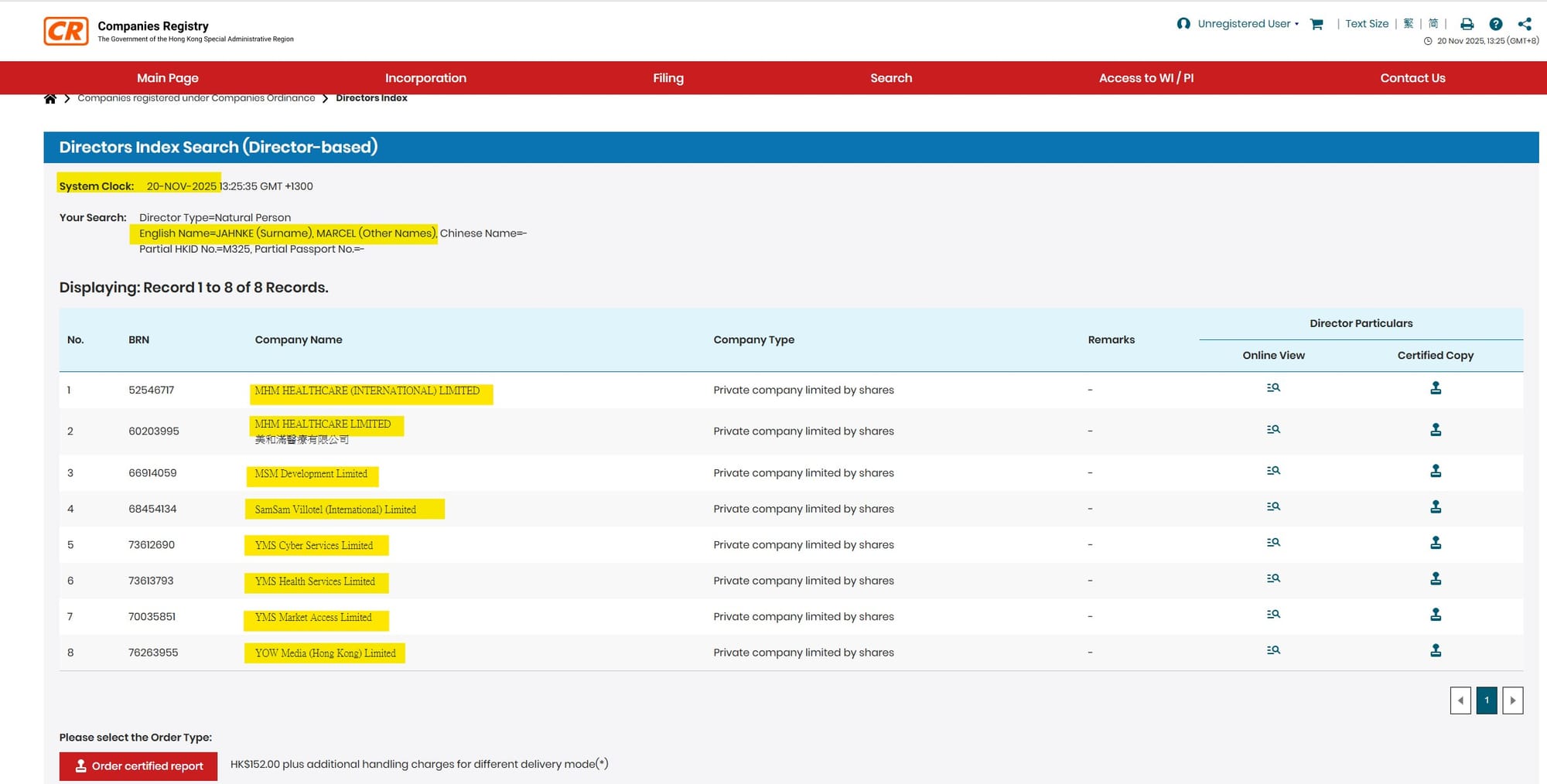
There is no space here to detail what I discovered about each of the numerous Hong Kong companies Jahnke was/is Director of, but suffice to say these include BigPharma, luxury resorts in Thailand, various investment companies and cybersecurity. But one entity in particular - YMS Market Access Ltd - caught my eye, because coincidentally a company with the same name cropped-up in my research last year ;) [a chocolate fish for the reader who remembers that].

Further digging revealed Jahnke gave a rare interview to Carl Zha in 2023 (paywalled) when he called Shanghai his “home” and heavily criticised his home country of Germany, saying:
“…the West is full of mediocre people, especially Germany, especially in the Government. No wonder people in the 90’s who had more than two brain cells predicted China is gonna steam-roll the West - like it should! Because China is simply a very superior system…”
Even though Jahnke admitted he was not present in China during Covid, he condemned the West for “... pushing the poison [covid 'vaccine'] on its people, which China did not." Mmmmm, maybe he 'forgot' about the apparent 3.4 billion shots administered there?! Jahnke stated this was the reason for the decline of trust in Western healthcare services. That's partly true, but as we know, multipolaristas and BigPharma play both sides. That's the whole point.
Using the tool of irony, language gets twisted and meanings become the opposite of reality. Lawyers perform injustice. Doctors, harm. Totalitarianism is the new 'freedom'. Does this mean a business investor as shareholder could actually play a role in conspiring to destroy that content creator/company, rather than developing it? In a world where Hrvoje claims multipolarista networks "appear to be attempting to muddy the waters and disguise the true roots of globalism" is this debt-for-equity strategy being used against us, repeatedly? Hidden in plain sight?
Lawyers are trustworthy (not)
As well as international records that are the equivalent of UK Companies House and NZ's Charities Services, I also search the open access Courts NZ and the database of UK legal court cases. And would you believe it, another coincidence!? There appears to be a company with the same name, YMS Market Access Ltd, listed in the Commercial Court regarding a 'general commercial contracts' dispute with the freedom-fighting community bank called Valhalla Network.
For those unaware of Valhalla, their 'Mission Statement' is stated by internationally-renowned finance academic - whom some may have seen on a Tucker interview (2m clip below) - Professor Richard A. Werner as follows:
In order to raise productivity, [we] need to establish many local community banks, which enable small firms to always upgrade to the latest technologies and hence be highly competitive and productive...” [2021] (my emphasis)
Financial Expert Prof Werner on Tucker
According to the UK database, further details of the Valhalla court case are currently unavailable. I can't help wondering if, like the Robert Cibis' OVALmedia case, debt-for-equity is involved too? Will these details (like the OVALMedia case) be censored? Can the public trust their courts to be fair and reasonable and to administer justice? Time will tell.
Lawfare and Debt for Equity
Robert Cibis explained how he, understandably, trusted his lawyer to behave professionally and to act in good faith. Unfortunately, that didn't seem to end well. When entities accept 'interest free loans' in good faith (as Cibis apparently did), is there high risk of lawfare being used to exploit equity? If something is 'free' - then YOU are the product! In this era of captured judicial systems, extra care needs to be taken with global commercial contracts, so that unintended consequences don't exploit IP and/or prevent information or services reaching new audiences or customers.
In our story about George and the Philanthropath, George's legal battle was in-part influenced by my discovery of the machinery of (covid era) lawfare in NZ. For instance, I have evidenced how professional legal privilege (between Government and lawyers) can be compromised when the ten biggest law firms in NZ are actually one registered company. Lawyers openly sharing confidential information, lawfully? Ironic indeed. Learn more here:
 Ursula Edgington
The covid era has brought new levels of scepticism about how 'just' our lawyers and judicial systems are. Can our courts be trusted anymore to protect the innocent? Is the justice system any different in Germany? Maybe, if Robert Cibis had been more discerning, full due diligence could have been undertaken? Could the entire OVALmedia documentary - rather than being 'black-shelved' - have benefitted from protected IP, and been published faster, more widely?
Hindsight is a wonderful thing. Our trust for one another as human beings is both our strength and our weakness.
Ways Forward
What can we do about all this? Returning to the question Steven and I posed in our story of George and the Philanthropath, highlighted at the top of this article: how can we survive this? Maybe knowledge of strategies like debt-for-equity that could capture, exploit or hijack alternative, 'independent' platforms are useful?
We are living in an era where nothing is quite what it seems. Multipolista networks seem ubiquitous, including UK Universities, selling their 'solution' to our global catastrophe. Often the opposite of what they claim (e.g. China didn't coerce it's citizens into taking the covid injections), is true. So this kind of analysis, using companies' registers, legal databases and other open access libraries proves invaluable when undertaking any due diligence - personally or professionally. Primary source evidence (not anecdotes or assumptions) are essential.
As an educationalist, I would argue that our curriculum needs now - more than ever - to provide solid training in due diligence. How many teachers are trained to deliver that kind of knowledge? (I think we all know the answer to that). Factchecking the fact-checkers is crucial, but sometimes it's not enough for survival in a world of bad actors (including pseudo-academics like these) who state the opposite of truth. Irony, satire, scepticism, curiosity (and maybe even a slight paranoia?!) are all approaches that should be praised and encouraged alongside due diligence - not silenced and stigmatised.
Let me know if I can assist you in this type of work, especially if its related to something I've described here. There is more to come on this topic. Stay alert to scams, trust your gut instinct.
Want to support my research writing? You can donate directly here so I can pay it forward to someone in need of my skills.