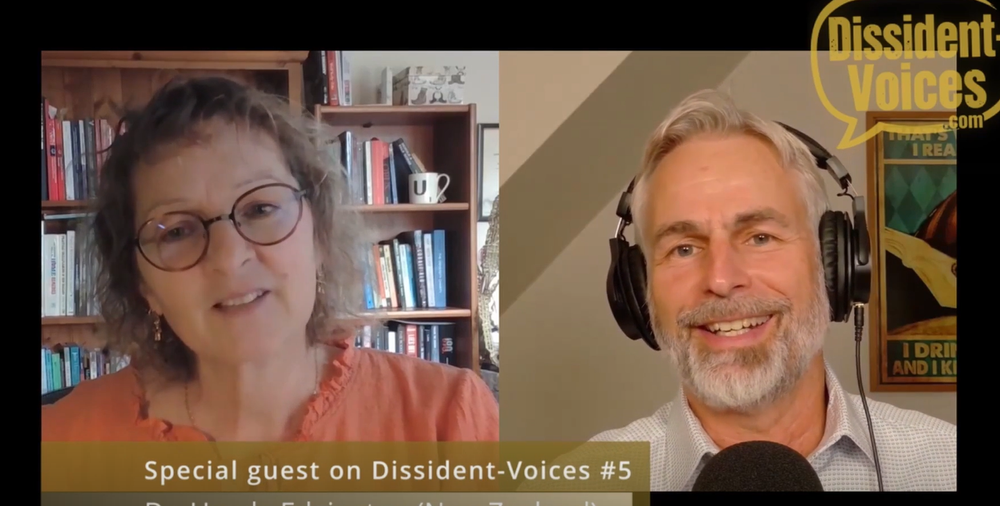
Dissident Voices: my conversation with Flemming
Many of you have already watched/listened the Dissident Voices 'Crossfire' discussion - the first of a new, regular event - that I shared last week. Thank you for all the positive and constructive feedback. It certainly was a very interesting conversation. Part 1 (1hr 10m) is available on the Dissident Voices website and I also shared it here:
 Ursula Edgington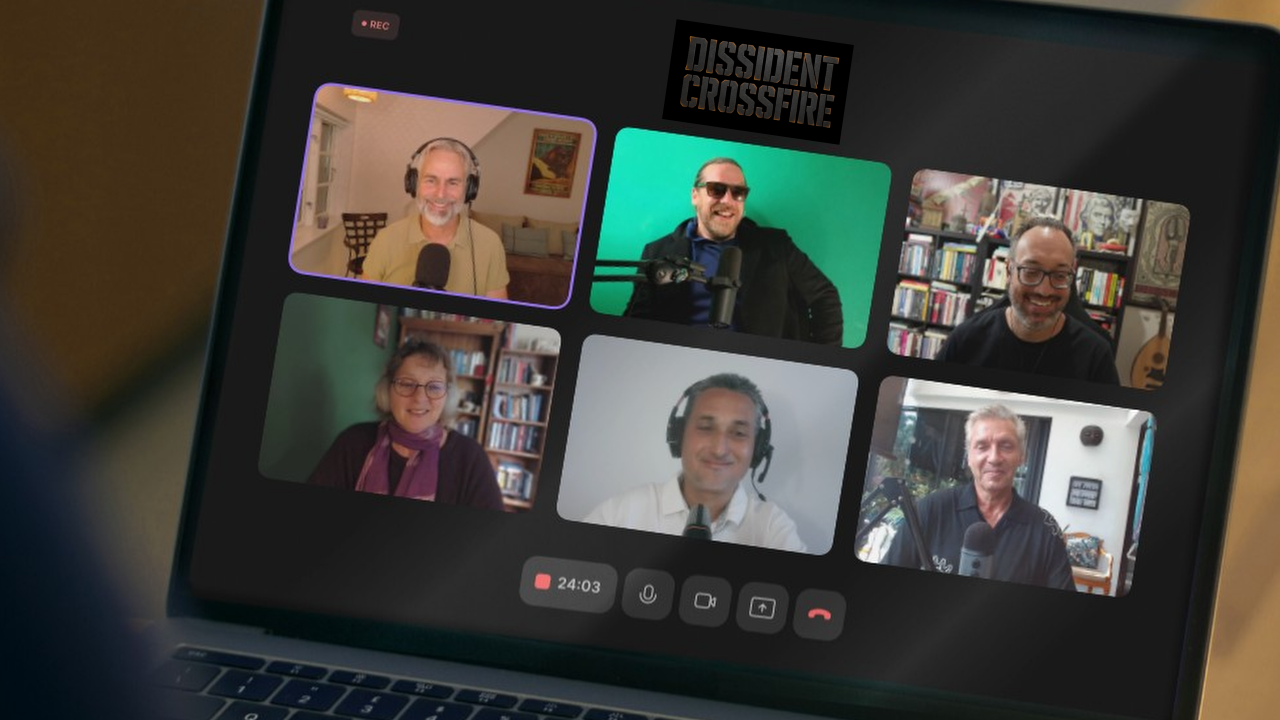
And Part 2 ( a further 1hr 10m) is behind a paywall, but Flemming Blicher of Denmark has kindly provided it to any of the panel's paid (or complimentary) subscribers, so if you are one of those, here's the link:
 Ursula Edgington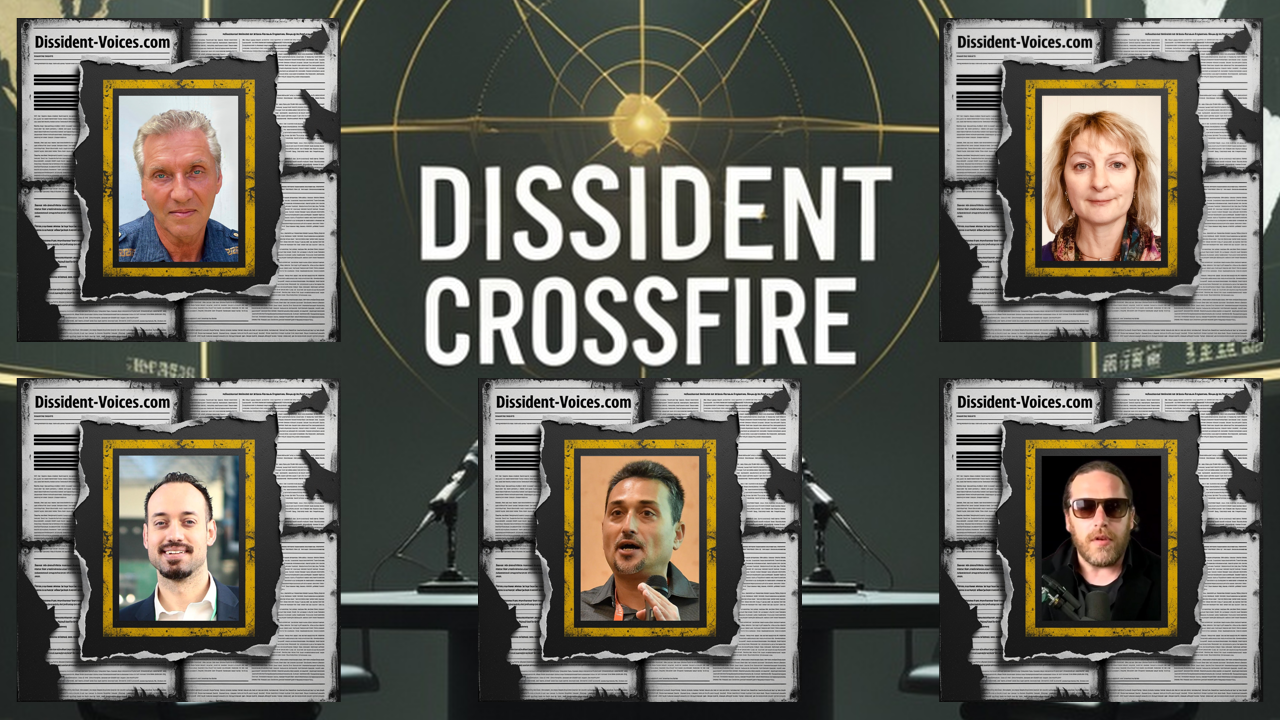
As I explained to Barak on Northland's Freedom Hub yesterday (I'll post that recorded conversation another time), if any of my readers are unable to afford to subscribe, but are very keen to have (private) access to Part 2, please contact me personally (eg reply to this Newsletter). The most important thing for all of us, is to encourage conversations about these topics.
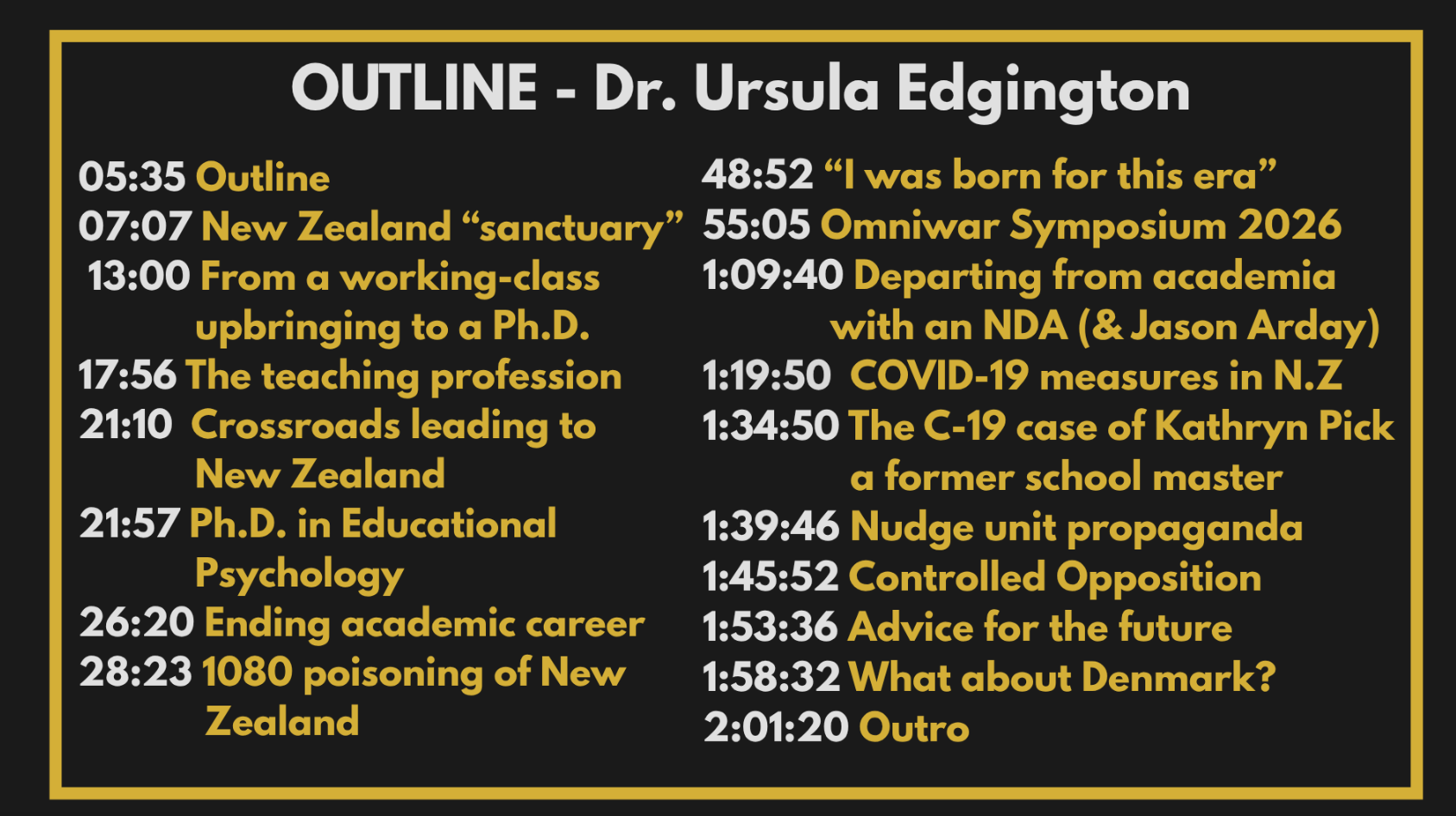
Before our Dissident Crossfire event, Flemming and I recorded a personal, long-form conversation. Topics we covered included the reasons why I was aware of the propaganda, which primarily was my research into the horrific aerial poisoning operations in NZ, that have a 70 year history. The parallels to the covid era propaganda are clear, and something I'm currently writing about (more on that another day). We also talked about the capture of academia and the situation in NZ. Here's Flemming's excellent summary of the topics with timestamps, to help navigate our 2 hour conversation:
For all of his 1:1 interviews, Flemming asks participants to complete a questionnaire that is very thoughtfully created. The questions and my responses are below:
Intro & Background
- What is your name, where are you from, and where in the world are you currently based?
I’m a British-born educationalist, who emigrated to New Zealand with my husband in 2013. For over ten years I’ve been an academic-in-exile, a blacklisted whistleblower, a part-time freelance adult tutor, an environmental activist, researcher and writer. I’m also a musician, domestic beekeeper and a dog-lover...
- What is your professional background, and what occupies most of your time today?
I’m from a working-class background so unsurprisingly, I left school as early as possible with no meaningful qualifications. Inevitably, I spent the next 15 years of my life moving from one location/job to another, hotels, sales, insurance, admin, merchandising etc, thinking ‘there must be something more to life than this?’… As a result of one of our relocations, I joined an evening class to ’make new friends’ where I caught the learning bug. I went on study p/t at the University of Warwick, obtain teaching quals (ESOL and PG)…then as tutor (‘sociology of health’) at a UK tertiary college I completed a Masters in Lifelong Education (Nottingham Uni). Later I won a scholarship to complete my PhD in educational psychology (Canterbury Christchurch), which focused on the potential harmful surveillance strategies applied to teachers in tertiary sectors (Edgington, 2016). As a lecturer in teacher-education programmes in universities in England and later in New Zealand, I published my research and presented at many international academic conferences.
Ten years ago, I saw corruption, discrimination and poor-quality teaching and learning at my institution, so I felt a duty to call it out. As a result, I became a victim of what I now recognise as the toxic university’s Corporate Playbook (Smyth, 2017): I was ignored, gaslit, bullied, harassed and finally subjected to lawfare and forced out (with a gagging clause). I didn’t realise at that time how, in the small population of NZ, I would subsequently become blacklisted for any academic/teaching role. So since then, I’ve gradually come to terms with the loss of my professional identity, my vocation in teaching and my connections with students and colleagues. The double-whammy was when covid hit even my unpaid teaching and research roles, for instance as volunteer tutor in a local prison, were unfairly ended, because of the covid ‘vaccine’ mandates.
In 2022 I completed a Masters in Legal Studies at the University of Auckland because I needed to better understand the capture of our judicial systems. Most of my time today is spent writing, researching and balancing the somewhat solitary moil of a dissident with rewarding jobs that enhance our self-sufficiency within nature.
🤐 Taboo of the Week
- What is a mainstream media topic, or an overlooked story, that you believe we are not allowed to discuss honestly—and why does it deserve our focus today?
New Zealand is a land of myths, some of which were ruptured thanks to globalist Jacinda Ardern. Today, many professionals, including teachers, nurses and other professionals who were mandated out of their vocations because of the covid vaccine mandates are still getting gaslit, excluded, ignored and blacklisted. Six years is a long time, and these are innocent people who donated their lives to caring for others, and whose skills are urgently needed in our communities right now. Their voices deserve to be heard and respected. Here’s a recent article about one case.
🧭 Becoming a Dissident
- When and how did you transition into becoming an outspoken voice within the alternative media landscape?
I wouldn’t say I am ‘in’ the alternative media landscape’ but I do try to contribute to it through various trusted channels. My original transition began when I arrived in New Zealand – because of my toxic experiences in the university I was working at, I was forced to come to terms with some of the harsh realities. Most New Zealanders are warm, generous kindly folk. But NZ culture suffers from extensive fraud, corruption, anti-intellectualism, nepotism, bullying and Tall Poppy Syndrome.
- Was there a specific catalyst or an exact moment you realized you could no longer subscribe to the mainstream narrative?
In 2014, I investigated the decades-old policy of aerial poisoning with 1080 (sodium monofluoroacetate) throughout New Zealand’s landscape and waterways. Like many others, I recognised this catastrophic form of ‘pest control’ to be one of the longest and most significant acts of ecological vandalism in the world. It was hidden in plain sight behind one of the most expensive PR campaigns in the world: ‘Clean, Green, 100% Pure NZ’. I was naively convinced (as many of us have since also experienced) that if we just pointed out the facts from the science that policymakers would see the truth and the environmental harms would stop. Ha ha! I had no idea how powerful the BigChem Corporate Playbook is. I was Committee member in the PeoplesInquiry2020.nz which received multiple submissions of evidence of harm from decades of this poisoning. In 2019 after our local mountain, including our town’s drinking-water reservoir, was aerially poisoned for the seventh time in twenty years, I realised that much of the ‘safe and effective’ mainstream media narrative was - and is - a lie. (Here’s one of my articles about that environmental harm with links to info).
- How did stepping outside the consensus impact your professional career and daily life?
When I was still lecturing at a university, I assumed that at least some (one?) of my academic colleagues, would support me when I called out the corruption and sought change. I had worked closely with these colleagues and believed we shared a passion for high-quality, student-centred teaching and learning – I considered them friends. I was shocked at the time when not one colleague stood up to management bullies. Unions too were simply corporate puppets. And since I was banned from Linkedin in 2022 for sharing an article from the BMJ that was counter-narrative (Godlee & Abbasi, 2021), I have not heard from any of my past connections.
So, in some ways, my ‘professional career’ ended ten years ago when I stood up to try to expose the extent of the universities’ corruption and discrimination. But in some ways, that’s when my career actually began. My family background, my teaching in healthcare, my PhD research into the marketization of education and teacher-surveillance, my experiences with corrupt academia – it’s as if I was born for this era.
My daily life now is unrecognisable compared to back then, I don’t publish in academic journals, I rarely get asked to peer-review, I don’t travel overseas, my teaching is via an agency in workplaces and my research outputs only have a relatively small audience. But I don’t regret that sacrifice, which is necessary in making a stand against tyranny. I do enjoy many aspects of the freedom my new role allows, which includes creative ways of raising awareness of the propaganda and censorship around us. From gardening workshops to music concerts, we all play a part every day in preventing (or at least delaying) the globalists’ plans.
- How has your work affected your personal relationships with family, friends, and former colleagues?
Without going into too much personal detail, my family was never close – geographically or emotionally. But like most people, our families have become even more disconnected and divided because of the covid era policies, censorship and propaganda. Illness and bereavement add to our frustration, anger and grief.
As to my former colleagues, there is only one I am still in contact with. But I have made connections with new colleagues all over the world, whom I am proud to trust and respect because they have also stuck by their values and principles and sacrificed their professional identities in exchange for speaking truth to power. You know who you are!
- Did other independent thinkers or dissidents guide you on your journey? If so, who stood out to you?
Like many other independent thinkers, I used to listen/watch to presenters who I now recognise are not really ‘freedom fighters’, but actually just spouting a different kind of propaganda. For instance, I used to support and contribute to UK Column News, and Voices for Freedom’s RCR in NZ, but after investigating these entities’ financial interests, I decided to focus on more authentic media platforms. David A Hughes’ article about ways to identify Camp 2 is extremely useful when careful discernment is needed.
- What is something about your journey into dissent that none of us know?
Maybe my dream? I’d love to facilitate the use of a physical building locally that could be an independent library, music hall and centre of authentic learning.
🛠️ Dissident Activities & Behind the Scenes
- Could you describe what a typical workday looks like for you?
I prefer mornings - my labrador always ensures she’s fed by 6am. I do my exercises, undertake any household chores, walk the dog and like to be home with a coffee at my desk by 9am to start work. I have a target of writing 1000 words a day – a throwback to my PhD days when self-discipline in writing is essential. Even if it’s rubbish, get it down on paper and edit it to something more meaningful later.
Most of my work is unpaid, usually I’m in a mentor-type role, supporting fellow dissidents in practical projects, writing reports, submissions, letters to MPs, complaints, articles, homeschooling meetings, networking. I also deliver (or help facilitate) community or workplace workshops. For instance, interactive sessions called “How to break up with your phone” and ‘How to be your own factchecker”.
My limited paid work is sometimes via private training agencies which can involve supporting apprentices (virtually or in person) in trades or healthcare complete their coursework and/or gain communication and leadership skills. Sometimes timing and funds for these contracts are flexible enough for me to add a session that helps chip away at a student’s cognitive dissonance.
We live a rural life here, so the change of seasons plays a significant part of my daily activities. These could include - cleaning/feeding my chickens; inspecting my beehives; feeding my lambs; preparing homemade products; harvesting and maintaining vegetables; moving firewood…and more. Because of our time zone, sometimes the beginning or end of my day is punctuated by an online meeting with overseas colleagues (or podcast interviews).
- What is your methodology when it comes to research? How do you separate signal from noise?
I think my ‘old-fashioned’ academic training allows me to delve deep into the original sources and ignore that ‘noise’. Not having any presence on social media is a blessing – not only to prevent unwanted, unnecessary distractions, but also to go into some subjects completely blind to the existing narrative/headlines. I owe much gratitude to those in my network who have provided insights into technology that helps with seeking online resources. But I do miss not having easy access to a comprehensive academic library – that is one of the biggest challenges to anyone seeking an independent learning environment in this era.
- Do you invest significantly in subscriptions or support for other independent creators?
Over the years I have, but now there are very few individuals I financially support. When Substack began its age-verification roll-out for Australians in Dec 2025, I took advice and moved my work and weekly newsletter to subscribers to my private website. This was also a significant personal shift – up until then, my personal ‘dissident’ life was somewhat separate from my ‘professional’ education consultancy work. After many years of my split personality, it was time to ‘come out’. Now, I am transparent about my activism, and open to any discussion that may emerge about potential tensions with those outside my usual network.
- What are the hidden costs of running an independent media platform that the audience might not see?
I don’t really run a ‘platform’ as such – only my website. I also enjoy helping others with their work too. Time is our most valuable commodity. This work is very time-consuming, but luckily, I don’t have too many other commitments, and my costs are helped by kind donations. I am also very lucky to have a supportive husband!
- To what extent do you utilize AI in your workflow, and do you rely on premium AI tools?
I hate any AI and strongly object to its use in any writing or research. I also cringe when I see fellow freedom-fighters using it without the skills needed to dissect its output, which can be hugely misleading and inaccurate. I avoid it completely in my day-to-day workflow. That is not to say that it’s not useful for transcription services and translations – both essential for a lot of my investigations (but still needs checking)!
As an experiment, I did co-author a creative story last year that was based on a case-study that made use of an AI programme. It had an interesting but somewhat disappointing outcome, I don’t think I would use it again in that context.
- Who are your own favorite dissidents or alternative media channels right now?
I don’t have many anymore. But as a ‘Pom’, I love to keep up to date with current British news, so independent presenters like Sonia Poulton and Richie Allen are wonderful daily or weekly ‘radio’ type shows to catch-up with whilst I undertake my chores. I think David A Hughes’ work is extremely valuable and deserves more readership – I watched the interview series you did reviewing his excellent book Wall Street, The Nazis and the Crimes of the Deep State which was very unusual in that you engaged deeply in the content. There’s not enough of that on any media platform today in my opinion – too much ‘noise’ and long, boring, repetitive and shallow conversations, not enough of intellectual engagement with uncomfortable truth.
- What is the best-kept secret about your day-to-day dissident activities?
Alongside my other ‘dissident’ activities, and self-sufficiency projects, I am chair of a local non-profit music group which organises concerts (mainly classical, easy listening too) at a local church. For over fifty years the groups’ mission is to bring high-quality professional musicians to the local community for a reasonable cost. I strongly believe that bringing people together, face-to-face, to enjoy music in an informal atmosphere like we do, is crucial if humanity is to survive the assault of technocracy. If your subscribers have a similar group of volunteers in your local community, please do support them!
- What exciting projects or content do you currently have in the pipeline for your audience?
I’m working on a number of projects now, including writing about a particular element of the fight against environmental poisoning in New Zealand that should be published soon. I’m continuing to work with teachers and nurses who seek accountability after the covid era, some of which is connected to the imminent NZ General Election in November. I’ve also been invited to present at the forthcoming Omniwar Symposium with David A Hughes and international colleagues. The theme of this fourth online event is something I’ve been investigating for the last six years: “The Capture of Academia”. And very timely after the public controversy of Jason Arday at Cambridge University.
🔮 Looking to the Future
- What is the ultimate impact or goal you are trying to achieve through your work?
I’m an educationalist by nature, so I continue to try to raise awareness of the strategies of propaganda theory, the addictive nature of BigTech, the surveillance machinery around us and the censorship of truth.
- Based on both your physical location and ideological perspective, what are the most likely local or global scenarios you see playing out in the near future?
My home country seems to be on the verge of civil war, which I find heartbreaking. However, that situation has been a long time coming and was one of the reasons why we left in 2013. Here in New Zealand ‘the phantom of the Five Eyes’ is in dire straits economically. With a small, sparse population with high levels of personal and national debt, the supply chain of food fuel is going to have a very damaging impact on everyone. The 2008 GFC did not disturb NZ lifestyles too much, hence many people are blasé about the potential risks all around them. A housing market crash is just beginning and long overdue. Those of us even slightly ‘prepared’ for what is ahead, could face extreme difficulties in trying to help those who remain in denial about the situation.
- What is one conviction you hold to be profoundly true that the vast majority of society would strongly disagree with?
That most of what is broadcast on legacy media is propaganda in some form – either in fake-news or infotainment.
💡 Closing Recommendations
- If you had a direct line to those currently holding the levers of power, what would your message to them be?
Most people are NOT psychopaths. But in my experience, those in positions of power are often promoted above their competence level and insecure in their roles. The strategies of reaching the propagandised are based on love, forgiveness and ego. Unless individuals can find some humility, they cannot let go of their professional identity - it’s too painful. The admiration that goes with their roles is too valuable to them to let go of and face the uncomfortable truth.
So my message to them would be to spend a day or more with those who are less fortunate than themselves, and to be authentic in addressing the challenges that brings. Maybe then, those individuals can humbly accept that they were wrong and only then can any accountability begin.
- What is your final piece of advice or recommendation for the audience watching/reading this interview?
Turn off your Tv or radio, encourage others too. Be aware of the risks from becoming addicted to your phone – see the tips for overcoming that here. Make efforts to socialise face-to-face with people and remember this is a long marathon, not a sprint – chip away at the cognitive dissonance with questions and eventually truth will win.
Did any of these questions/responses spark your own opinions or experiences? Let me know in the comments!
Please do subscribe (as a free or paid member) of Flemming's Dissident Voices project for further interesting in-depth interviews like this, and more Dissident Crossfire monthly events. And please share this article to help overcome the censorship and shadow-banning.
Thank you for your support!