Covid-era books, thoughts on some of my reading...
In a world of propaganda and censorship, books are soul-food. Buy, read, give and share widely.
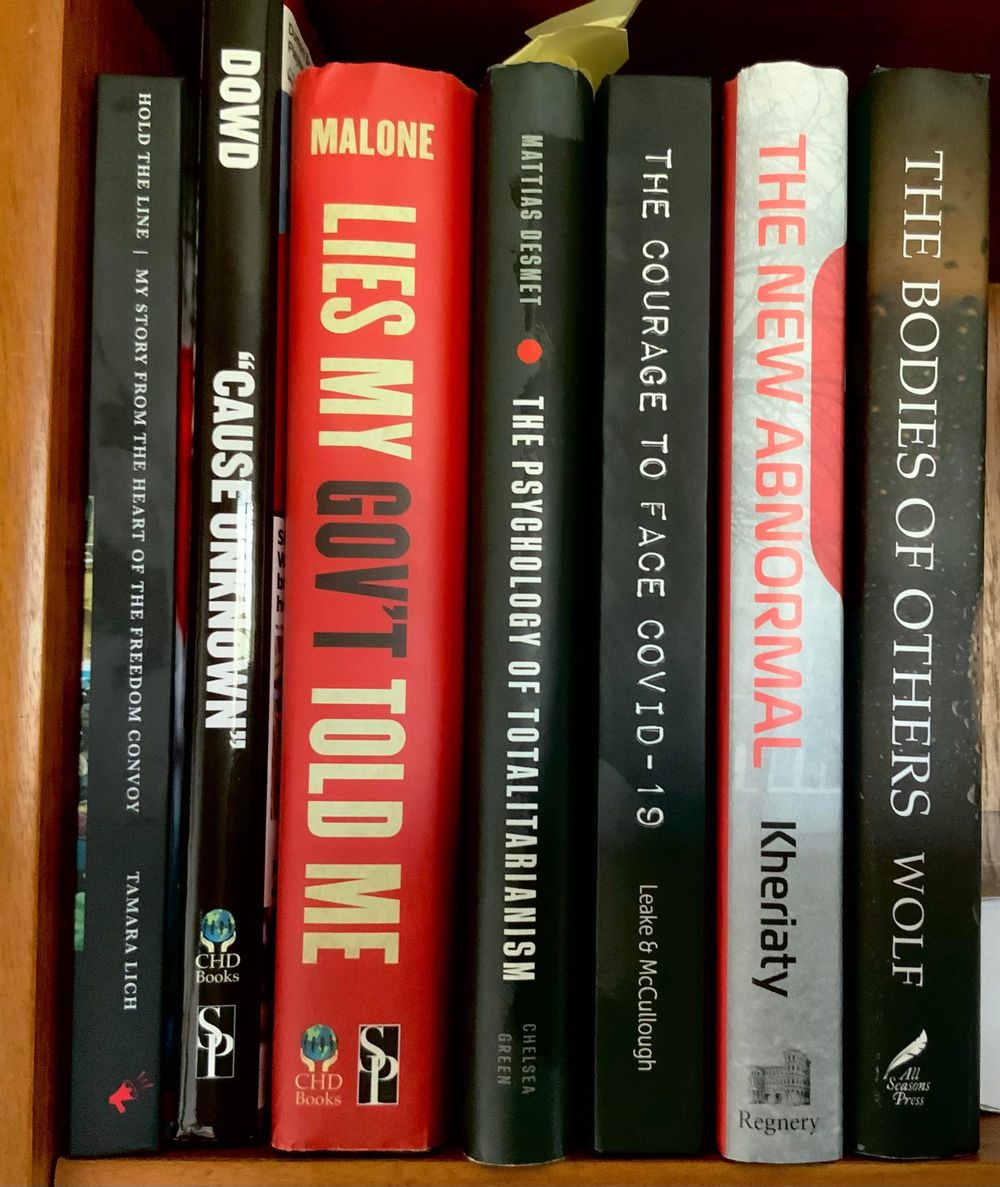
Above are the seven books I’ve chosen to summarise - not for any particular reason other than they are ones I’ve read in hard-copy rather than Kindle and stick-out to me as future ‘seminal’ pieces in what I’m sure will be an historic era for publishing books outside the censorship platforms. The seven authors couldn’t be from more different backgrounds: Dowd, Desmet, Lich, Leake & McCullough, Kheriarty, Malone & Wolf. Financial investments; clinical psychology, physical training, criminology, cardiology, ethics, medicine, journalism… diverse indeed.
As ‘background’ reading, other books (published BC - Before Covid) are essential, methinks. Books like Bullshit Jobs by David Graeber and Unspeak by Steven Poole. Have you, like me, also just finished re-reading Orwell’s 1984 (re-reading because we all read it at school, right)?! There are so many fascinating parallels in Orwell to our current situation. The re-writing of history is so poignant when we look back on the gaslighting of the last three years. The final part about Winston’s torture is particularly confronting, especially when reflecting on the time at the height of the covid craziness, authorities knocking doors here, to ‘capture’ those who refused to get ‘vaccinated’. We were right to be terrified of this tyranny.
Anyway, I’m thinking about some of the other books I’ve read recently. Here are the seven recently-published ‘covid era’ books, and a short para summarising my thoughts about them.
1. Edward Dowd “Cause Unknown” 2022 (USA) This is a very visual book – tragically collating the evidence from ‘screenshots’ of those who have ‘died suddenly’ - mainly sources from local newspapers after the jab-roll-out. The structure is designed to capture those with potentially short attention-spans. There are also important research extracts from life-insurance data and other statistics. Shocking, direct and difficult for anyone to dismiss or ignore. Professionally-written and clearly presented. QR codes on each page to the original source is a very effective way of referencing the information – assuming you have a smartphone to zap them!
2. Mattias Desmet “The Psychology of Totalitarianism” 2022 (Belgian). Some useful visuals and diagrams to help illustrate points. Although written by an academic, the style and structure is engaging for an inquisitive lay person. Lots of references to investigate, depending upon the reader’s curiosity. International in scope, but Euro-centric in context. Desmet has been criticised for discounting the ‘it was all planned’ theory (as opposed to the ‘opportunistic’ theory), but this interpretation is complicated and overall I think his book is probably the most useful overview of the complex behavioural science issues from a societal level. Considering this is an English translation of the original Flemish, the book is a great accomplishment and will likely be one that is useful to refer back to in the years ahead. Useful references from a range of interdisciplinary sources at the end listed by chapter.
3. Tamara Lich “Hold the Line” 2023 (Canadian). Sadly, no visuals at all! This book is a useful timeline and stream-of-consciousness type journal from the serendipitous female ‘leader’ of the famous Canadian Convoy of Truckers. This was a particularly dark time when Governments took a totalitarian turn to freeze not only protestors’ bank accounts, but also those who donated and supported them. There are a few disappointing editing issues, including repetitions and other minor typo-errors that some readers may find annoying. The context of the challenges the Truckers had to overcome is useful to know. Some of these people are still blacklisted for credit today, apparently. Personally, I expected to read more details of the camaraderie and the atmosphere that we saw on the videos from the event, eg the realities of the food provided and the characters of those involved. An inspirational woman’s story without being explicitly feminist. References are only provided by actual website addresses as footnotes – not helpful in a hard-copy book (again, something a proper proof-reader could have addressed).
4. Leake and McCullough “The Courage to Face Covid19” 2022 (USA) This is an interesting timeline too, but from an ‘experts’ perspective. In depth descriptions about the (mis)reporting in MSM of the covid risks and the academic censorship are interesting. I was disappointed by the disjointed way the book is formatted – chapters are written by either Leake or McCullough, but sometimes both authors contribute to one chapter. The result (because each writer understandably has a very different style) is some repetition and change of tone or first-person narrative which is jarring. Fantastic for the encyclopedic references that McCullough is famous for reeling-off (although I would have preferred these to be footnotes rather than at the end of the book). This was one of the earliest books to be published. Will there be a follow-up?
5. Aaron Kheriarty “The New Abnormal” 2022 (USA) Another one of my favourites, and one of the more professionally-presented books. Philosophical rather than journalistic in approach. Thoughtfully written, from a multi-disciplinary experienced writer. Again, even though the author is an academic, the style and format of the book makes it very engaging for any curious reader. Anecdotes are given weight by court case documents. The focus is on the ethics and law in an education environment, so could be particularly valuable to those in teaching and learning roles, or medical ethics. Full references as endnotes are useful for further investigations. No visuals.
6. Robert Malone “Lies my Government told me” 2022 (USA) Well-presented but does have some annoying repetitions, this is less philosophical and more ‘big-picture’ context to the covid era. Has some useful US Government and UN/WHO historical context and some ‘solutions’ offered at the end. Malone makes some unique observations, for instance about the MBA content and how this has steered business. Again one of the books to be published early-on, and substantial in its scope and approach. No visuals.
7. Naomi Wolf “The Bodies of Others” 2022 (USA/UK) Internationally-renowned, Oxford-educated Wolf has written a very compassionate, personal account of her awakening experiences during covid which spans central USA cities like New York and visits to Europe. Her experiences trying to communicate her concerns about the propaganda machine with her highly-educated colleagues in senior positions in society are poignant to read. Her spiritual reflections, from her Jewish background, together with her journalistic style is highly engaging. Out of all the above books, I would recommend this one as a potential ‘gift’ to an awakening friend or family member. No visuals, but plenty of of imaginary ones in her descriptions and many references to follow-up including economic data. A book that will appeal to a broad range of readers.
More books are on reading list, and I will write proper reviews as and when time allows… Please comment with other suggestions for reading lists!